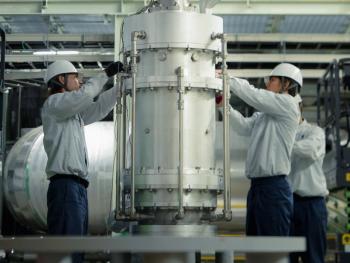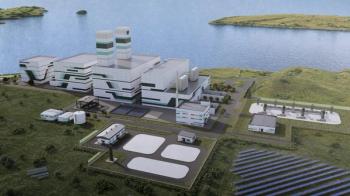
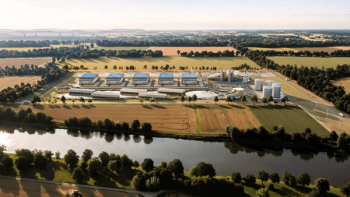
The Port of Victoria project would be only the second U.S. project to pursue NRC construction licensing for the GE Vernova Hitachi Nuclear Energy boiling water SMR design.
The performance of threaded fasteners – screws, nuts, and bolts – is critical in commercial engineering. The Fastener Quality Act of 1990 was enacted by Congress after several high-profile fastener failures, like the San Francisco bridge collapse, according to the National Institutes of Standards and Technology.
Lambda Technologies Group, a materials research laboratory, released a study showing how threaded fastener fatigue life can be dramatically improved by using compressive residual stress.
In an experiment conducted on a threaded rod manufactured from B7 steel (AISI 4140, ASTM) AI93), Lambda Technologies used Low Plasticity Burnishing (LPB) to introduce high compressive residual stress into a threaded fillet. Fatigue testing showed the LPB samples had a fatigue life 15 times greater than the untreated specimens.
Low Plasticity Burnishing is a patented mechanical process that applies pressure to the surface of metal components using a custom-designed hydrostatic burnishing tool. The pressure is delivered with enough force to generate plastic deformation, compressing a layer of the metal so that it resists damage from foreign objects, corrosion fatigue, fretting, stress corrosion cracking, and other common damage mechanisms.
"The LPB process provides a means of introducing an optimal compressive residual stress in the thread root where failures occur," explained Doug Hornbach, CEO of Lambda Research, Inc., the research and materials testing laboratory that is part of Lambda Technologies Group. "Manufacturing processes used to form threads do not produce the compression that can be generated with LPB. Shot peening, which is a widely used surface enhancement method, will dimple and distort the thread face while not adequately treating the thread root. LPB works because we can design custom-shaped tooling that fits into the root of the thread."
Lambda conducted this experiment on steel, but LPB can be performed on almost any alloy.
"The speed at which we can treat the screws and bolts is another major benefit of the process," commented Paul Prevéy, CEO of Surface Enhancement Technologies (SET), the division of Lambda Technologies Group that develops surface treatment solutions for commercial engineering applications. "LPB is performed on conventional CNC machines. With customized tooling installed on a high-speed lathe application, LPB is applied in a second or less."