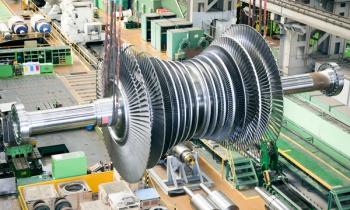
Learn how shutdown deposits trigger turbine corrosion, erosion and oil varnish—and the maintenance steps that boost steam turbine reliability.
The ITER Project achieved a major machine assembly milestone, as the first sub-section of the ITER plasma chamber was successfully lifted out of tooling and lowered into the machine well. The weight of the component plus rigging was 1,380 tonnes. The multilayer rigging arrangement, added to an already tall load, left the crane operators with a clearance of only 20 cm over the concrete wall that delimits the machine assembly well. The teams achieved millimetre-level tolerances in the positioning of a component that towers six storeys high and weighs the equivalent of four fully loaded Boeing 747s.
The section lowered represents one-ninth of the toroidal plasma chamber. It is a composite assembly, formed from one 40° vacuum vessel sector fitted with silver-coated thermal shields, and two D-shaped vertical superconducting electromagnets called toroidal field coils. Eight other similar assemblies will form the complete chamber and surrounding toroidal field coil superstructure.
The creation of the composite assembly took place on specialized tooling in the ITER Assembly Hall between March and December 2021. The components were first lifted to vertical on a specially adapted “upending” cradle and transferred to a standing tool capable of docking the vacuum vessel sector in its center and rotating the other components in on its wings.
This major lifting operation took several months to prepare for the entire ITER and DYNAMIC SNC team, the Franco-Italian joint enterprise in charge of the TAC2 contract and formed by Ansaldo Nucleare, Endel Engie, Orys Group ORTEC, SIMIC, Ansaldo Energia, and Leading Metal Mechanic Solutions SL. On the ground, the operation was carried out by DYNAMIC SNC with crane operator Foselev and metrologists, coordinated by ITER Organization