
2025 orders hit a four-year high as gas turbine backlogs push data center developers toward a faster fix, but the rebound is landing just as one of the industry's largest OEMs explores selling the business behind it.
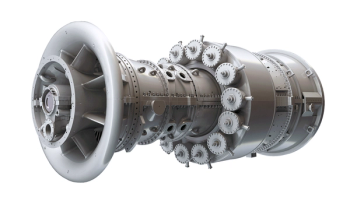
The FLEX4H2 technology uses the company’s Constant Pressure Sequential Combustion system, which burns fuel across two stages and allows independent control, lower emissions, and more.
At Hydrogen Research and Innovation Days 2025, Ansaldo Energia’s
“Hydrogen deployment in gas turbines will be a key enabler for clean electricity production and future grid stability,” said Andrea Ciani, Project Coordinator at Ansaldo Energia. “This achievement reflects the strength of a committed team that brings together scientific, technical, and industrial expertise.”
The FLEX4H2 technology uses the company’s Constant Pressure Sequential Combustion (CPSC) system. Sequential combustion is a two-stage process which burns fuel in two distinct steps, enabling the independent control of each stage. With the CPSC system, FLEX4H2 enhances fuel flexibility, improves operational stability, and enables lower emissions, specifically when burning hydrogen-rich blends.
For Ansaldo Energia, fuel flexibility is a strategic priority and a primary enabler for the energy transition. Operating turbines on wide-ranging fuel blends, including high shares of hydrogen up to 70%, is a key aspect of Ansaldo Energia’s initiative to decarbonize power generation while securing grid stability and reliability. The project’s success is credited to collaboration between industry, research centers, and universities, and represents a step toward 100% industrial hydrogen combustion by 2030.
In December 2025, Ansaldo Energia agreed to deliver one hydrogen-ready GT26 gas turbine and one steam turbine, with respective generators, to the new combined-cycle
During operation, the new power plant may reduce CO2 emissions by up to approximately 70% in comparison to the retiring lignite facility. With the GT26 gas turbine, a future integration of up to 30% hydrogen in the fuel blend will further reduce emissions. The turbine also delivers a net efficiency of approximately 60% in combined-cycle configuration, leading to lower fuel consumption, reduced emissions, and competitive generation costs across the load range.
Ansaldo’s GT26 also features sequential combustion to enable quicker load ramps. The turbine’s design permits highly flexible operation with low emissions across a wide compliancy window, optimizing responsiveness to demand peaks and intermittent renewables. It maintains flexibility without derating while operating on hydrogen blends. The Mátra Power Plant will also demonstrate a minimum environmental load of approximately 30%.
In June 2025,
“This project is about resilience and flexibility,” said Brian McMullan, Project Lead for Kilshane Energy. “As Ireland moves toward a net-zero energy system, we need reliable backup generation to complement the growing renewable fleet. The technology from Ansaldo Energia is not only flexible and robust, but it also offers a future pathway to decarbonization, with the potential for hydrogen blending and other low-carbon fuels.”