
2025 orders hit a four-year high as gas turbine backlogs push data center developers toward a faster fix, but the rebound is landing just as one of the industry's largest OEMs explores selling the business behind it.
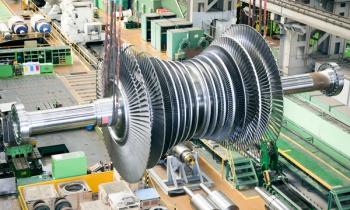
The GT26 gas turbine will aid Hungary’s decarbonization and power supply initiatives by delivering lower CO2 emissions, hydrogen-ready capabilities, faster load ramping, and more.
Per an award from MVM Mátra Energia, Ansaldo Energia will deliver one hydrogen-ready GT26 gas turbine and one steam turbine, with respective generators, to the new combined-cycle
“We are proud to contribute to this strategic project with Ansaldo Energia’s technology, creating lasting value for our customer,” said Stefano Gianatti, EVP, Thermal New Units of Ansaldo Energia. “Gas turbines once again prove themselves an effective instrument of the energy transition, delivering the flexibility, reliability, and efficiency that the system and the business demand, while contributing to CO2 emissions reduction.”
During operation, the new power plant may reduce CO2 emissions by up to approximately 70% in comparison to the retiring lignite facility. With the GT26 gas turbine, a future integration of up to 30% hydrogen in the fuel blend will further reduce emissions. The turbine also delivers a net efficiency of approximately 60% in combined-cycle configuration, leading to lower fuel consumption, reduced emissions, and competitive generation costs across the load range.
Ansaldo’s GT26 also features sequential combustion to enable quicker load ramps. The turbine’s design permits highly flexible operation with low emissions across a wide compliancy window, optimizing responsiveness to demand peaks and intermittent renewables. It maintains flexibility without derating while operating on hydrogen blends. The Mátra Power Plant will also demonstrate a minimum environmental load of approximately 30%.
In addition to Hungary’s public utility, MVM, the customer is a consortium composed of Status KPRIA (part of the Mészáros Group), WEST HUNGÁRIA BAU, and ELSEWEDY ELECTRIC Power Systems Projects.
In early October 2025, Ansaldo Energia completed several upgrades at
Prior to the upgrades, the company anticipated a 43-MW power increase, 0.9% efficiency improvement, and a reduction of over 10,000 tons of CO2 emissions per year. However, after the initial operational tests, Ansaldo Energia observed even better performance than first forecasted. The upgrade strengthens the plant’s role as a flexible and highly efficient asset, supporting Italy’s national energy security and energy transition.
In May 2025, TAQA ordered four Ansaldo Energia AE94.3A gas turbines, generators, and associated services for its recently commissioned 1-GW
These AE94.3A gas turbines will strengthen the UAE’s overall energy infrastructure and security, offering high performance, operational flexibility, reliability, and cost efficiency. It can respond quickly to fluctuating grid demands, adapting to systems integrated with intermittent, non-dispatchable renewable energy sources. The Al Dhafra plant is connected to and supported by a large-scale photovoltaic park.