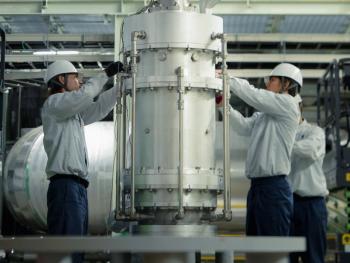
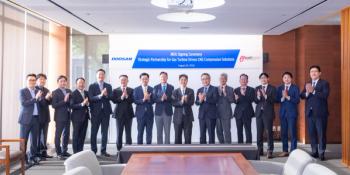
Ebara Elliott Energy and Doosan will integrate gas turbines and centrifugal compressors for LNG trains, targeting commercial readiness in 2028.
Hanwha Power commissioned three fuel gas compressors for the 950-MW Trumbull Energy Center, marking its entry into the U.S. market.
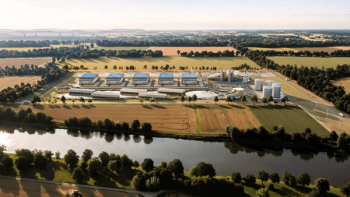
Hanwha Power has completed commissioning of its first U.S. fuel gas compressor installation, supplying three units for the 950-MW Trumbull Energy Center combined-cycle gas turbine (CCGT) power plant in Ohio. The June 24 opening ceremony marked the start-up of the facility and Hanwha Power’s formal entry into the U.S. power generation market, according to the company.
The project brings together Korea Southern Power Co. (KOSPO), Gemma Power Systems, Siemens Energy, Ohio state officials, the Korean Consul General, project lenders, and other stakeholders. Hanwha said the plant was originally developed to help address the generation gap created by retirements of aging coal-fired assets and is expected to serve the Pennsylvania-New Jersey-Maryland (PJM) Interconnection, the largest wholesale electricity market in the United States.
For rotating equipment and turbomachinery professionals, the Trumbull project highlights the growing importance of fuel gas compression as CCGT plants are called on to provide dispatchable capacity in regions with variable demand, changing fuel infrastructure conditions, and ongoing coal retirements.
Hanwha Power supplied three fuel gas compressors (FGCs) to the plant. The units use variable frequency drive (VFD) technology designed to automatically adjust compressor operation in response to extreme seasonal pipeline pressure fluctuations common in the PJM region, the company said.
That capability is significant for CCGT operation because fuel gas delivery pressure must remain within the acceptable operating envelope of the gas turbine fuel system. When pipeline pressure drops, compressors must provide adequate boost without creating instability, excessive thermal loading, or control issues. When pipeline pressure rises, the system must reduce compression demand efficiently while maintaining reliable fuel delivery. VFD-based operation can help align compressor speed with actual fuel pressure requirements, supporting smoother operation and potentially reducing unnecessary energy consumption compared with fixed-speed operation.
Beyond supplying the compressors, Hanwha Power secured a nine-year long-term service agreement (LTSA) covering capital spare parts and maintenance services through three major overhaul cycles. The company said its Houston service center will act as the primary hub for on-site support and component refurbishment.
For plant owners and EPCs, the agreement reflects a broader market shift: turbomachinery suppliers are increasingly expected to support equipment over the full lifecycle, not only through initial installation and commissioning. For critical balance-of-plant rotating equipment such as FGCs, long-term parts availability, repair capability, outage planning, and overhaul execution can directly affect combined-cycle availability.
The use of a U.S.-based service center also has practical implications for North American operators. Localized repair and refurbishment support can shorten logistics timelines and improve responsiveness during planned outages or unexpected equipment issues.
Hanwha framed the Trumbull commissioning as a foundation for expanding its service and equipment footprint in the North American market. Prakash Nair, Hanwha Power’s Chief Commercial Officer, said securing both the equipment supply contract and LTSA “reflects the confidence” placed in the company’s technical and operational capabilities and establishes a basis for long-term participation in U.S. power generation.
Joo Mong Choi, CEO of Trumbull Asset Management, said the commissioning and compressor deployment demonstrate the reliability of Korean power generation technology in the U.S. market while supporting stable power supply to the PJM grid.
The Trumbull Energy Center underscores several priorities for new-build and repowered gas-fired plants: flexible compressor control, resilience to pipeline pressure variability, service-backed lifecycle planning, and integration of balance-of-plant turbomachinery into broader reliability strategies.
As grid operators depend on efficient CCGT assets to replace retiring coal capacity and support variable generation, the performance of auxiliary rotating equipment will remain central to plant availability. Hanwha’s first U.S. FGC commissioning gives the company a reference project in a major power market—and gives operators another data point in evaluating compressor technology and long-term service models for high-efficiency gas turbine facilities.