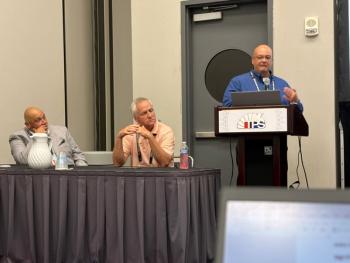
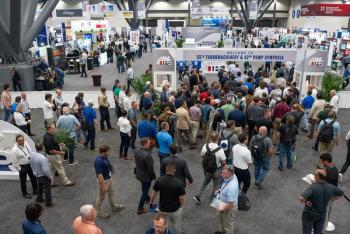
At the 2026 Turbomachinery and Pump Symposia, Opportune’s Dan Romito warned that grid constraints and a five-year gas turbine backlog are pushing AI data centers toward on-site power, while colleagues honored the legacy of the late Dara Childs.
The new engine was developed with knowledge from fundamental studies on hydrogen-related materials and combustion, in addition to durability testing of fuel injection systems.
Japan Engine Corp. and Kawasaki Heavy Industries are advancing development of a
As part of the program, Japan Engine has developed a fully Japan-made, large, low-speed, two-stroke hydrogen-fueled engine. The 6UEC35LSGH, described as the world’s first full-scale engine intended for installation on an actual vessel, has begun hydrogen co-firing operation in all cylinders. The engine has achieved a hydrogen co-firing ratio of over 95% at 100% load, confirming greenhouse gas reduction effects and stable operation. Verification testing will continue to optimize performance under hydrogen co-firing conditions.
While hydrogen-fueled vessel demonstrations have progressed in Japan and internationally, many efforts have focused on short-distance, low-output applications such as sightseeing boats and tugboats using compressed hydrogen. This project pairs the high-efficiency, high-output, low-speed, two-stroke 6UEC35LSGH engine with liquefied hydrogen fuel to enable long-distance, long-duration operations suitable for oceangoing merchant ships.
Japan Engine said development of the engine builds on prior studies of hydrogen-related materials, combustion behavior, and durability testing of hydrogen fuel injection systems. Following verification, the engine is scheduled for shipment in January 2027 for installation as the main engine of a 17,500 DWT hydrogen-fueled multi-purpose vessel to be designed and built by Onomichi Dockyard.
Kawasaki is developing and manufacturing the MHFS, a hydrogen fuel supply system for the engine, which will also be installed on the vessel. Mitsui O.S.K. Lines and Onomichi Dockyard have concluded contracts related to construction of the vessel, and agreements have been reached among the participating organizations on required facility specifications. Detailed vessel design is currently underway.
The vessel is scheduled to undergo three years of demonstration operation starting in fiscal year 2028 under the operation of Mitsui O.S.K. Lines and MOL Drybulk. Throughout development of the engine and MHFS, as well as the vessel’s design, construction, and operation, Nippon Kaiji Kyokai will conduct safety evaluations. With support from NEDO, the participating companies will continue working toward practical operation of hydrogen-fueled merchant vessels as part of broader efforts to advance sustainability in the maritime industry.
Earlier this month, Kawasaki Heavy Industries (KHI) constructed a facility at its Harima Works in Kako-gun, Hyogo Prefecture, to demonstrate its
The next-generation centrifugal compressor features ultra-high-speed rotation, enabling larger volumes of hydrogen gas to be compressed to high pressure in a smaller space compared to existing equipment. As a result, the demonstration facility requires approximately one-seventh of the installation space needed for conventional hydrogen compressors. The system also incorporates optimized gas cooling and high-efficiency impellers, reducing annual electricity consumption by 3% to 4% compared to existing technologies.