The company raised $8 million to commercialize factory-built supercritical CO₂ systems designed to recover exhaust heat from simple-cycle gas turbines.
Baker Hughes will supply NovaLT16 and Frame 5 turbines for Kodiak projects targeting up to 1.8 GW of behind-the-meter power.
Baker Hughes will supply Kodiak Gas Services with gas turbines and generators under a multi-year agreement designed to support as much as 1.8 GW of distributed power generation capacity. An initial equipment award covers approximately 1 GW scheduled for delivery by 2030.1
The order combines Baker Hughes NovaLT16 and Frame 5 gas turbines with BRUSH Power Generation generators. Kodiak plans to deploy the equipment in scalable, behind-the-meter projects serving data centers and energy infrastructure in key U.S. markets.
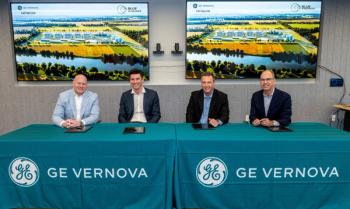
The companies signed the agreement in Houston, with Baker Hughes Vice President of Sales for Gas Technology Equipment Riccardo Barbieri and Kodiak Chief Financial Officer John Griggs representing the organizations at the ceremony.2
The initial award includes two gas turbine platforms and BRUSH generators, giving Kodiak a mixed equipment portfolio for distributed generation projects. Baker Hughes did not disclose the number of units, individual package configurations, project locations or commercial value of the order.
The NovaLT16 and Frame 5 machines will form the core of Kodiak’s planned power-generation fleet. Pairing the turbines with generators from the same supplier framework could help coordinate equipment delivery, technical interfaces, training and lifecycle support across phased projects.
Kodiak President and CEO Mickey McKee said access to Baker Hughes’ technology, training and support would strengthen the company’s ability to provide dependable, efficient and rapidly deployable power at scale.
For turbomachinery operators, the inclusion of training, spare-parts commitments and a potential long-term service agreement is significant. Those provisions can support maintenance planning, technician readiness and parts availability as multiple sites enter operation. They may also help Kodiak standardize operating practices across a growing fleet, although detailed service terms have not been announced.
The agreement targets markets where electricity demand is rising faster than available grid capacity. Behind-the-meter generation places power assets at or near the customer’s facility, reducing reliance on the timing of utility interconnections and transmission expansion.
This model is particularly relevant for data centers, where phased construction and high availability requirements can create demand for generation that is both modular and rapidly deployable. Baker Hughes Chairman and CEO Lorenzo Simonelli said accelerating demand from digital infrastructure makes the ability to bring reliable and efficient capacity online quickly increasingly important.
The rolling agreement allows capacity commitments to be adjusted around changing data-center demand and project-development schedules. Rather than committing the full 1.8 GW immediately, Kodiak can align equipment deployment with customer requirements and site readiness.
The scale and phased structure of the program create several execution priorities for engineering, operations and maintenance organizations. Package integration will require coordination among turbine, generator, electrical and balance-of-plant systems. Site teams will also need to account for installation sequencing, commissioning resources, controls integration and maintenance access.
A mixed fleet can provide deployment flexibility, but it also increases the importance of configuration management and platform-specific competency. The agreement’s focus on technical training and spare parts indicates that both companies are addressing operational readiness alongside equipment supply.
Baker Hughes and Kodiak said the framework is intended to deepen technical collaboration, streamline project execution and reduce lead times. If the full pathway is exercised, the arrangement could establish a sizeable new installed base of gas-turbine-driven distributed generation serving U.S. digital and energy infrastructure.