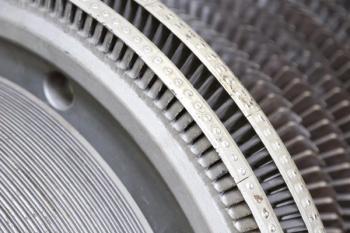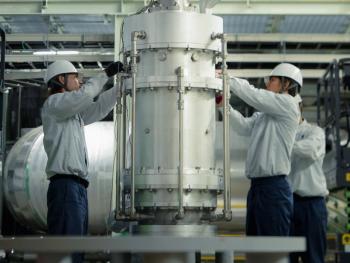
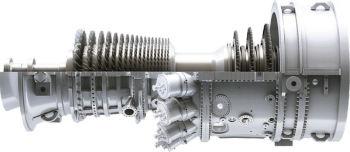
GE Vernova will perform rotor life extension work on five 9F gas turbines in Egypt, adding 13 to 15 years of life to about 1,250 MW of capacity.
Conventional centrifugal pumps, those with mechanical seals, need to provide a stable environment for the seal to obtain the maximum life from the seal. Part of this stability comes from keeping the seal faces parallel to each other with minimum vibration. In single stage overhung pumps, the shaft is a cantilevered beam with a circular cross section supported by the bearings with a concentrated load, the impeller, at the end.
The formula for deflection of the shaft is: Deflection (D)= W*l^3/(3*E*I) where W is the weight of the impeller, l is the length/distance from the center of the impeller to the first bearing, E is the modulus of elastisity for the material, and I is the moment of inertia for this beam configuration. Most process pumps have shafts that are made of 4140 steel. For circular cross section beams, such as pump shafts, this reduces to SR=l^3/d^4 where d is the diameter of the shaft at the seal area. This is refered to as the siffness ratio.
Industry experience has shown that a lower stiffness ratio can improve seal life. Published information indicates a stiffness ratio below 60 will help keep deflection at the seal face low enough to improve seal life. This was particularly important as industry transitioned from packing to seals as packed pumps had long skinny shafts which contributed to short seal life. If the shaft is made of a different material, the formula would need to be recalcuted. Some pumps made of polymers run quite satisfactorily with stiffness ratios over 200.
Most manufacturers provide options for their pumps that affect the initial price. A larger diameter shaft requires larger bearings and a larger bearing housing, thus increasing the price. However, if the installation life is for several years versus a few months, the life cycle cost will be reduced because of the improved reliability.