
Siemens Energy is rebranding as Omterra, unifying its gas turbine, compressor, and Siemens Gamesa wind portfolios under one corporate identity.
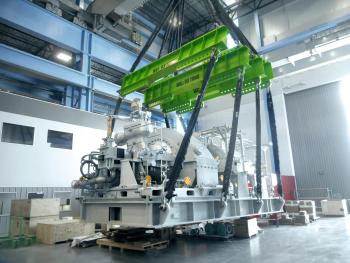
The core equipment was manufactured and tested at Mitsubishi Heavy Industries Compressor Corp.’s facility in Hiroshima, Japan, and was delivered in April 2024.
Mitsubishi Heavy Industries Compressor International Corp. (MCO-I) successfully delivered an advanced CO2 product compressor package to ExxonMobil’s carbon capture and storage (CCS) expansion project in LaBarge, WY. The core equipment, delivered in April 2024, was manufactured and tested at MHI Compressor Corp. (MCO) in Hiroshima, Japan.
“We are honored to collaborate with ExxonMobil on this landmark project,” said Michael McCurry, Account Executive, MCO-I. “Our longstanding relationship with ExxonMobil in the petrochemical market and our capability to manufacture and test large, vertically split type machines were key factors in our selection. We incorporated unique technologies to facilitate the installation and removal of the large bundle during maintenance periods, ensuring operational efficiency and reliability.”
MCO-I conducted the packaging work in Pearland, TX, ensuring integration while allowing the end-user to execute final inspections and familiarize themselves with the package locally. Personnel from both MCO and MCO-I were involved in manufacturing, testing, installation, and commissioning support of the compressor package for ExxonMobil’s CCS project.
Other MHI News
In mid-September 2024, Mitsubishi Heavy Industries
KM CDR was installed at Eni’s Casalborsetti natural gas treatment plant by NEXTCHEM, the project’s technology integrator, while KT Integrated E&C Solutions completed engineering, procurement, and construction works at the site. MHI delivered the process design package and is licensing the technology. At the plant, MHI’s carbon-capture process treats low-CO2 flue gas from a natural gas turbine driving a turbocompressor. With CO2 concentration levels less than 3% and low atmospheric pressure in the exhaust, the technology is reducing CO2 emissions by 90% with peaks of 96%.
News from ExxonMobil
In early September,
Upon startup, the facility could produce more than 1 million tons of low-carbon ammonia per year and up to 1 billion cubic feet per day of low-carbon hydrogen, with approximately 98% of CO2 removed. Project construction, through job creation and community development support, will economically benefit Baytown, the Houston area, and Texas.
And, in July,