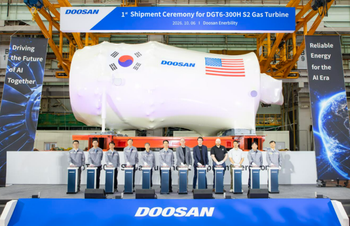

The behind-the-meter framework covers 720 MW units delivered from 2028 through 2034, mainly for LNG operations, with data centers as a possible add-on.
Researchers at the National Energy Technology Laboratory have demonstrated stable, sustained rotating detonation using a novel CFD-designed aero-strut injector, marking a key step toward practical pressure gain combustion and higher-efficiency gas turbines.
Researchers at the National Energy Technology Laboratory (NETL) have demonstrated stable, sustained detonation across a range of operating conditions using a novel aero-strut injector—a critical step toward pressure-gain combustion in commercial gas turbines.
Rotating detonation engines (RDEs) are a leading candidate for achieving a step-change improvement in gas turbine thermal efficiency. Conventional gas turbine combustors rely on deflagrative combustion, where a subsonic flame front burns through a premixed or partially premixed fuel–air mixture at nearly constant pressure. This process typically results in a modest pressure drop across the combustor (often less than 5%), which is accepted as a necessary penalty for stable combustion.
RDEs operate on a different physical mechanism. They sustain one or more detonation waves that continuously propagate around an annular combustion channel at supersonic speed. Each detonation wave compresses, burns, and expands the reactants in a very thin reaction zone, producing a net pressure rise across the combustor instead of a pressure loss.
This thermodynamic approach—known as pressure gain combustion (PGC)—is theoretically up to 25% more efficient than conventional deflagrative combustion. For power generation and industrial gas turbines, which already push the limits of aerodynamics, cooling, and materials, even small efficiency gains are difficult to achieve. PGC offers the potential for a step change:
The main barrier has been hardware implementation. Maintaining a stable, repeatable detonation wave under varying fuel flow rates, air–fuel ratios, and inlet pressures—without destructive instabilities—has kept RDEs largely confined to research facilities.
Researchers at the U.S. Department of Energy’s NETL announced the design and experimental validation of a novel injector configuration for RDE applications that directly addresses this hardware challenge.
Led by Justin Weber of NETL’s Advanced Turbines research group, the team used high-fidelity computational fluid dynamics (CFD) to redesign the fuel–air injector feeding the detonation chamber. Earlier injector concepts were prone to startup instabilities, where the detonation wave could not be reliably initiated or sustained.
By systematically modeling how injector geometry, flow distribution, and fuel–air mixing affect detonation wave formation and propagation, the team developed a novel aero-strut injector. This configuration:
Minimizing injector pressure loss is essential: any loss at this stage directly erodes the pressure gain that makes RDEs attractive.
Validation took place on NETL’s water-cooled RDE test platform, an experimental rig designed to withstand the extreme thermal and pressure loads associated with high-pressure detonation.
Testing confirmed:
These results indicate that the aero-strut injector is viable for integration with real gas turbine hardware, not just as a laboratory curiosity.
For turbomachinery engineers, injector stability is central because it directly affects turbine durability, performance, and operability.
An RDE with a detonation wave that:
will generate large, unsteady pressure transients. Downstream turbine components—stator vanes, rotor blades, and transition ducts—are typically designed for the relatively steady total pressure profile of a conventional combustor. Erratic detonation behavior exposes these components to highly unsteady, asymmetric loading, which can:
Research on the turbine–RDE interface has shown that a mismatch between the detonation wave propagation direction and the turbine blade flow-turning angle can cause stagnation pressure losses exceeding 10%. Such losses can negate much of the benefit of pressure gain combustion.
NETL’s prior work has also demonstrated that the full pressure gain benefit—with combustor pressure ratios up to 2.2× the inlet condition—is only realized when the detonation process is continuous and thermodynamically consistent. If the injector allows partial deflagration, intermittent waves, or wave dropout, the system loses the very efficiency advantage that justifies adopting RDE technology.
The new aero-strut injector directly targets this issue by providing stable, repeatable detonation over a practical operating range.
NETL’s result moves pressure gain combustion from a theoretical opportunity toward engineerable hardware for turbine-scale systems. Demonstrating that CFD-guided injector design can:
significantly reduces technical risk for original equipment manufacturers (OEMs) and system integrators considering RDE-based combustors.
The U.S. Department of Energy has set a target of >70% lower heating value (LHV) efficiency for natural gas combined-cycle (NGCC) plants. Achieving this with conventional approaches—higher firing temperatures, better thermal barrier coatings, and improved cooling schemes—is increasingly constrained by materials limits and cooling technology.
Pressure gain combustion is one of the few remaining pathways to a step-change efficiency improvement rather than incremental gains. By demonstrating a practical injector solution, NETL has:
NETL’s Advanced Turbines Program plans to continue:
If successfully integrated, RDE-based pressure gain combustion could help NGCC plants and industrial gas turbines achieve higher efficiency, lower emissions, and reduced footprint, supporting both economic and decarbonization goals.