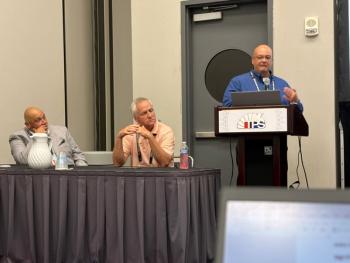
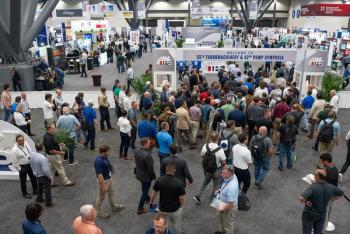
At the 2026 Turbomachinery and Pump Symposia, Opportune’s Dan Romito warned that grid constraints and a five-year gas turbine backlog are pushing AI data centers toward on-site power, while colleagues honored the legacy of the late Dara Childs.
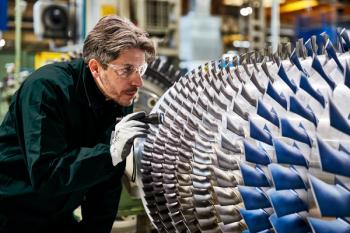
Due to ammonia’s high flame temperature, the combustion system must leverage an appropriate thermal barrier coating system to protect its nickel-based metal alloy hardware.
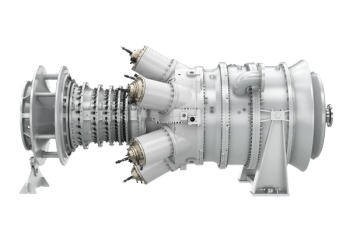
Similar to hydrogen or other alternative fuels, combusting ammonia requires special considerations for materials selection, emissions control, and routine maintenance schedules. PSM’s ammonia combustor technology is no different, as Jeffrey Benoit highlights the performance and reliability criteria that must be satisfied for the Hanwha-Baker Hughes ammonia propulsion project.
At POWERGEN International 2026, Benoit highlights low NOx production and established maintenance intervals as two considerations toward commercial availability, especially for a maritime application: Strict emissions regulations are already in place for marine propulsion, and, given the nature of ocean-going vessels, timely maintenance must be conducted in port.
TURBO: What material considerations are important when designing components for prolonged ammonia exposure?
Benoit: We need to recognize that complete combustion is important. We must ensure, from a geometry and mixing standpoint, that we are providing a uniform mixture in our combustion system—this is important to consider materially. Also, because we’re handling a flame that radiates a lot of energy into the combustion system’s hardware, having the correct thermal barrier coating system around the nickel-based metal alloy is vitally important.
We must ensure that the [thermal barrier] can endure sustained high temperature, as well as cyclic capabilities and switching between ammonia and natural gas. The use of high-fidelity computational fluid dynamics and chemical kinetic models are done at the beginning of the design process, allowing us to create the geometry to house the combustion process.
TURBO: What are the key performance and reliability criteria that must be met before commercial availability?
Benoit: The critical performance will be oxide of nitrogen production. We will install a selective catalytic reactor, which is essentially more ammonia, to reduce the NOx coming from the gas turbine to the appropriate levels for an air permit. This is required not only in a maritime application, but also in a land-based application. The other will be maintenance intervals: How often do we need to perform routine maintenance on this hardware?
With a gas turbine, after years of operation, the hardware will be extracted for refurbishing and reuse and then we install new hardware. Being able to schedule maintenance in a reliable and timely way for maritime-based gas turbines is vital…