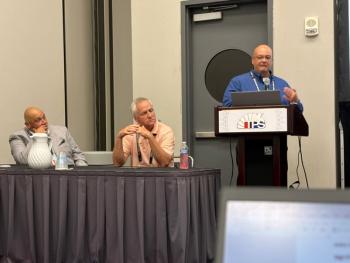
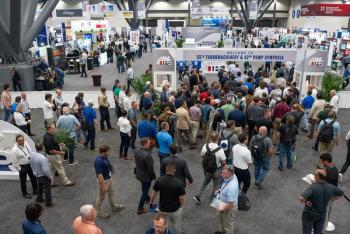
At the 2026 Turbomachinery and Pump Symposia, Opportune’s Dan Romito warned that grid constraints and a five-year gas turbine backlog are pushing AI data centers toward on-site power, while colleagues honored the legacy of the late Dara Childs.
The environmental product declarations tracked data on resource consumption, emissions, waste generation, and recyclability for the mtu Series 4000 DS2500 and 1600 systems.
Rolls-Royce supplied mtu-brand emergency power generators, verified with
“With these environmental product declarations, we set a new industry standard for environmental transparency in the field of energy systems,” said Tobias Ostermaier, President of Stationary Power Solutions, Rolls-Royce Power Systems. “This is our response to growing demand from our customers, and we are actively supporting them in reducing their carbon footprint. Our EPDs create transparency for customers, authorities, and partners—and prove that sustainability is measurable and verifiable.”
This newly certified service offering provides extended maintenance intervals: Instead of monthly reviews, operators must only test their emergency power systems on a quarterly basis. The minimized check-in schedule significantly reduces both costs and emissions. The EPD International System is an independent, globally recognized organization based on the ISO 14025 and EN 50693 standards. Registered declarations contain intricate data on resource consumption, emissions, waste generation, and recyclability.
For Rolls-Royce’s power generators, the EPDs outline all phases of the product lifecycle—from supply chain to transport, assembly and operation, to maintenance and decommissioning. The lifecycle assessment data was gathered by Sphera, while Rolls-Royce contributed real production and operating data from its manufacturing facilities and suppliers.
Currently, mtu emergency power generators are approved for sustainable fuel operations with hydrotreated vegetable oil (HVO) and additional e-fuels. HVO serves as a full replacement for fossil diesel without technical modifications. Modern mtu exhaust gas aftertreatment, in combination with sustainable fuels, reduces CO2, NOx, and particulate emissions by more than 90%.
This week,
Per the data center agreement:
With these technologies and services, the partners are establishing a system that generates electricity while filtering CO2 from the engines’ exhaust gases—a key aspect in decarbonizing the growing data center industry. The contract also provides Rolls-Royce with additional power capacity in the data center market and furthers the joint development of HVO-compatible solutions.
AVK supplies complete critical power solutions equipped with mtu Series 2000 and 4000 diesel engines, with power outputs ranging between 825 – 4,000 kVA. The company installs and then maintains these systems throughout their service lifecycles, and, in the past 10 years, Rolls-Royce has delivered 600 mtu gensets to AVK. For over 20 years, Rolls-Royce’s mtu gas engines have served as the primary emergency power system at AVK sites. Data centers must retain data and keep computing power available 24/7—even during public grid failures—so an emergency power system is always required.