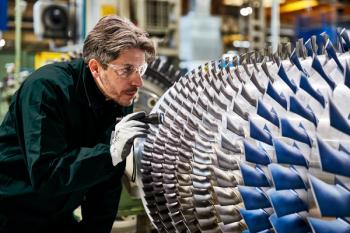
Record IET orders fuel Baker Hughes’ $37B backlog as LNG liquefaction and data-center power turbine demand accelerates, reshaping supply chains.
As hyperscalers, colocation providers, and utilities invest in new power generation infrastructure, rotating equipment and flow control technologies will play a critical role.
The AI-driven buildout of data centers is driving one of the most dramatic increases in U.S. electricity demand over the past 50 years. As hyperscalers, colocation providers, and utilities invest in new power generation infrastructure, rotating equipment and flow control (REFC) technologies will play a critical role. They are essential across the entire ecosystem, from gas turbines that generate the electricity powering data centers, to compressors that transport the natural gas fueling those turbines, and to pumps, valves, and actuators that circulate and regulate cooling water and other fluids to maintain reliable and efficient data center operations.
However, not all REFC technologies will experience the same level of growth. This paper provides an overview of the expected U.S. growth outlook across key REFC technologies.
Key findings include:
The scale of investment is staggering. Total investment in AI data-center infrastructure is estimated to reach approximately $7 trillion through 2030. According to the IEA, global data centers consumed around 415 TWh of electricity in 2024, with consumption expected to more than double to 945 TWh by 2030, an incremental load comparable to Germany's entire national power demand.
In the U.S., data centers are projected to be the single largest driver of new electricity demand, contributing 65 to 90 GW of incremental peak load — potentially up to 12% of total U.S. peak demand within the next several years. Meeting this demand will require an "all of the above" approach spanning natural gas, renewables paired with battery storage, nuclear, and emerging technologies such as fuel cells and enhanced geothermal.
Natural gas fired power generation is expected to capture a significant share of incremental U.S. electricity demand through 2030 due to its dispatchable generation capability, relatively lower fuel costs, and existing natural gas infrastructure. Industry estimates suggest ~50% of new data-center power supply through 2030 could be gas-based, particularly for facilities requiring high power reliability or located in regions where grid connection does not exist for renewables.
Gas Turbines — Heavy-Duty | Estimated CAGR to 2030: 20%+
Heavy-duty gas turbines are the primary beneficiary of the AI data center buildout. With power outputs exceeding 600 MW for H-class machines, thermal efficiencies above 65%, and dispatchable baseload capability, they are well-suited for the largest hyperscaler projects. The market, with leaders GE Vernova, Siemens Energy, and Mitsubishi Heavy Industries (MHI), is experiencing record order books and increasing lead times of 3 to 4+ years. GE Vernova reported a 77% increase in its Q4 2025 Power order book; Siemens Energy recorded its highest-ever quarterly order intake in Q1 FY2026; and MHI saw Energy Systems bookings increase 45% year-over-year. All three OEMs are expanding manufacturing capacity, though most additions will not come online until ~2028 and these OEMs are approaching further capacity additions with caution in the event that demand moderates toward the late 2020s and early 2030s.
Industrial Gas Turbines & Aeroderivatives | Estimated CAGR to 2030: 15%+
Supply constraints in the heavy-duty segment are pushing developers toward medium-sized industrial gas turbines and aeroderivatives. Industrial turbines (modular and skid-mounted for faster deployment) have been a particular beneficiary for companies such as Solar Turbines (Caterpillar), which reported Q4 FY2025 sales growth of 23% and plans to expand capacity 2.5x by 2030. Aeroderivatives, derived from jet engines, offer rapid installation and compact footprints, though at lower efficiency than heavy-duty units. GE Vernova's LM2500+ leads the market, while supply chain constraints have resulted in new entrants such as FTAI Aviation and Boom Supersonic moving forward with converting retired commercial engines for power generation. However, aeroderivatives have lower efficiency, resulting in higher costs that could impact business case underwriting for some projects.
Reciprocating Gas Engines | Estimated CAGR to 2030: 15%+
The large backlog and long-lead times for gas turbines are driving significant demand increase in gas engines, which are increasingly being deployed for both baseload and backup power generation. Offering installation timelines of roughly 18 months and lower upfront capital costs, key OEMs reporting significant growth include Caterpillar (including recent agreements with Vertiv and Joule Capital Partners), Wärtsilä (29% Energy division sales growth in Q4 2025), INNIO Jenbacher (which secured a mega-order for 1.5 GW of power from VoltaGrid) and Rolls-Royce Power Systems, whose data center power generation products grew nearly 50%. The downside trade-offs from operators and developers are the significant lower efficiency and higher emission levels of gas engines.
Steam Turbines | Estimated CAGR to 2030: Mid-to-High Single Digits
Steam turbines are benefiting from combined-cycle plant deployments and nuclear life-extension programs, though their near-term outlook is more modest than gas turbines due to longer deployment timelines and higher capex for large balance of plant requirements. A significant portion of steam turbine demand is driven by the nuclear industry. Nearly 50 reactors in the U.S. are pursuing Subsequent License Renewal (SLR) approvals to extend plant life from 60 to 80 years, with the IEA estimating capital expenditure exceeding $500 million per 1 GW plant. These programs involve significant steam turbine overhauls, creating meaningful opportunities for refurbishment specialists alongside the major OEMs.
Compressors | Estimated CAGR to 2030: Low Single Digits
Natural gas compressors are indirect beneficiaries of the buildout, driven primarily by pipeline expansion to support gas-fired power generation and fuel gas compression within power plants. Pipeline operators including Williams, Kinder Morgan, and Energy Transfer have announced over $10 billion in expansion investments over the next 3 to 4 years. However, the scale of compressor demand remains modest relative to other infrastructure buildouts such as U.S. LNG export capacity.
Industrial Pumps | Estimated CAGR to 2030: Low Single Digits
Industrial pumps growth remains relatively modest compared with other large pump end-markets such as water and wastewater and oil and gas. Three key demand areas are: cooling system pumps (growing at over 20%), ancillary pumps for gas-fired power plants (a large combined-cycle plant can contain 40 to 60+ pumps), and pump upgrades for nuclear life-extension programs. Grundfos and Xylem are several of the companies beneficing on the cooling system, while Flowserve, which reported 40% year-over-year growth in power bookings including $110M in new nuclear orders, is strategically positioning itself to be a market leader in the nuclear segment. Overall, however, the aggregate impact does not fundamentally reshape the pump industry.
Valves, Actuators & Mission-Critical Components | CAGR: Low Single Digits to 20%+ (Varies by Segment)
Growth in valve and actuator demand broadly tracks the build-out of infrastructure and balance of plant systems that support turbines, pumps and cooling system infrastructure deployment. Similar to pumps, the overall growth impact from data centers remains relatively modest compared with the overall market size and does not fundamentally move the needle at this stage. For example, industrial automation player Honeywell noted data center revenues are approaching ~5% of total sales.
Mission-critical components generally tracks the growth of their underlying rotating equipment and flow control technologies. The majority of component OEMs are witnessing accretive growth uplift, with gas turbine blades and buckets investment casting vendors such as PCC and Howmet Aerospace forecasted to grow at rapid double-digits. For example, Howmet has indicated that its gas turbine business could double to $2B in the next few years. Other such as forging suppliers, hydrodynamic bearing vendors and labyrinth sealing OEMs are also seeing significant growth, particularly those with U.S. manufacturing capacity.
Aftermarket Services | Estimated CAGR to 2030: Mid-Single Digits+
The strained supply chain and long-lead times for certain REFC technologies are also impacting the maintenance and servicing of existing assets and plants. Many of the parts, components, resources, and repair shop capacities used in aftermarket refurbishment overlap with those required for original equipment manufacturing. As many OEMs increasingly prioritize new equipment orders, this has created significant pressure on aftermarket services, refurbishment capacity, and spare parts availability.
These constraints are leading to very long-lead times and significantly higher prices, forcing operators to evaluate ways to extract more from existing assets or delay upgrades until the new equipment demand subsides. As a result, utilities, independent power producers (IPPs), and industrial operators are accelerating life-extension programs, output and efficiency upgrades, and other refurbishments.
This presents significant growth opportunities for many independent service providers (ISPs) such as Ethos Energy, IPS, and PSM and other specialty service firms. ISPs with gas turbine exposure, parts repair capabilities, and integrated service platforms are best positioned to capture this opportunity. This segment has attracted substantial M&A interest, with recent transactions including Ethos Energy's acquisition of Turbine Services and Arcline's purchase of Rotating Machinery Services.
About the Article
This article summarizes the key findings of the JFMA Consulting white paper 'The AI Power Surge: How Data Center Growth is Impacting the U.S. Rotating Equipment and Flow Control (REFC) Markets,' published March 2026. JFMA Consulting is an independent advisory firm serving industrial companies operating in rotating equipment and flow control technologies. For further information, contact frank@jfmaconsulting.com or visit jfmaconsulting.com.