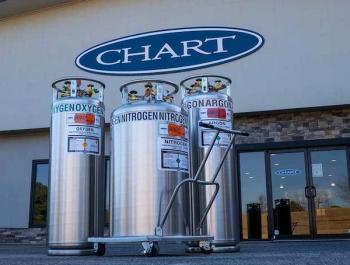
Baker Hughes completes its Chart Industries acquisition, forming a new industrial segment with expanded capabilities in LNG, hydrogen, and thermal management.
The MK2 project will convert Golar’s LNG tanker—Fuji LNG—into a floating LNG vessel with an expected annual production capacity of 3.5 million tons.
TMC Compressors was contracted by CIMC Raffles to supply a complete marine compressed air system for the
“This is a major vessel that requires a large-capacity compressed air system,” said Hans-Petter Tanum, Director of Sales and Business Development, TMC Compressors. “Operating far from shore, operational reliability is obviously key. That is exactly what we are aiming to ensure with our system, which has been designed solely for marine and offshore use.”
The MK2 FLNG project will convert Golar’s LNG tanker—Fuji LNG—into an FLNG vessel with an expected annual production capacity of 3.5 million tons. It will be lengthened by nearly 100 meters and, once completed, the FLNG vessel will be approximately 390-meters-long and 70-meters-wide. The converted facility will be a floating platform that processes LNG at sea, far from shore, and stores it before offloading to LNG carriers for global transport.
Oslo-headquartered TMC Compressors has not disclosed the contract’s value, but the marine compressed air system will be delivered in 2027.
In June 2025,
“The efficiency of Meyer Werft’s compact shipyard is reflected by its short production and logistics routes,” said Tanum. “As a Norway-based supplier, with manufacturing and assembly in Europe, we are able to support tight delivery schedules with our marine compressed air system. LNG is increasingly being used as primary fuel for both operations at sea and in port, and the fuel has become an important steppingstone toward a carbon-neutral maritime industry.”
In addition to a complete marine compressed air system, TMC will also supply the air treatment system for the starting air system. The contract value is undisclosed. Since 2018, Meyer Werft and Meyer Turku have built nine cruise ships with LNG propulsion for four cruise lines for Carnival Corp., per a joint technical platform. The two new ships will also be built on this platform.
In May 2025, TMC announced that it’s supplying a
The electrical motor’s speed will continuously self-adjust to a precise air volume that matches the actual compressed air consumption value. With lower overall air consumption, the compressor may operate at lower speeds and consume less power.