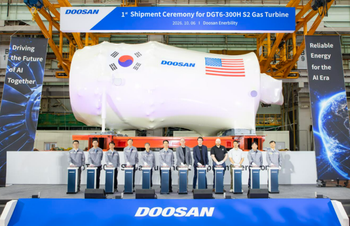

The behind-the-meter framework covers 720 MW units delivered from 2028 through 2034, mainly for LNG operations, with data centers as a possible add-on.
Velo3D and Aurelia Technologies have announced a strategic partnership to qualify metal additive manufacturing for next-generation gas turbine components, targeting design consolidation, faster iteration, and supply chain resilience.
Velo3D, Inc., a metal additive manufacturing (AM) company, and Aurelia Technologies, a developer of fuel-flexible small-scale gas turbines, announced a partnership to advance additive manufacturing for next-generation gas turbine systems.1 The collaboration is structured as a phased program covering component feasibility evaluation, material and process development, and progression toward qualification and low-rate initial production using Velo3D's Sapphire XC platform.
For OEMs and component suppliers, the partnership is another signal that metal AM is moving from prototyping into production-track qualification for turbine hardware. Aurelia's approach centers on design consolidation—using AM to combine traditionally multi-part assemblies into fewer, integrated components, reducing fasteners, joints, and tolerancing stack-ups that have historically been sources of maintenance risk in high-temperature, high-stress environments.
By reducing reliance on long-lead forgings, tooling-intensive processes, and large inventory commitments, Aurelia says it can respond faster to design changes and market demand while lowering working-capital exposure. [1] The companies note that geometry updates or feature changes could be implemented and produced in weeks rather than months—a meaningful shift for an industry where casting and forging lead times remain a persistent bottleneck, particularly amid the current surge in gas turbine demand tied to data center power needs.
The initial phase will evaluate where AM can deliver measurable benefits in performance, lead time, and manufacturability across select turbine components and high-performance alloys, with a disciplined path toward production readiness rather than a wholesale redesign push.
"Additive manufacturing allows us to simplify designs, reduce failure points, and move faster while staying grounded in proven turbomachinery fundamentals and materials science," said Karol Hricisak, PE, Director of Technology at Aurelia Technologies.
Michelle Sidwell, Chief Revenue Officer of Velo3D, framed the deal as evidence of where AM's impact is greatest: "Advanced energy systems are pushing the limits of traditional manufacturing. Aurelia is taking a thoughtful, engineering-driven approach by designing with additive manufacturing in mind from the beginning, which is where the greatest impact can be realized."
Both companies say the partnership is structured for long-term expansion, with additional applications, qualification programs, and production scaling expected as Aurelia's turbine platforms mature. For the turbomachinery sector, the deal adds to a growing body of evidence that AM qualification pathways for high-temperature alloys are maturing—a development worth watching as more OEMs assess additive options for next-generation power generation hardware.