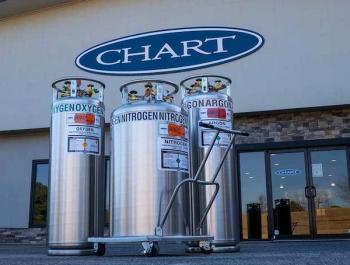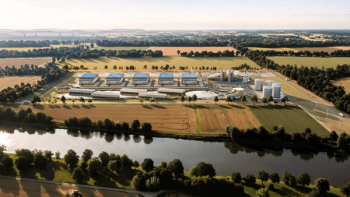
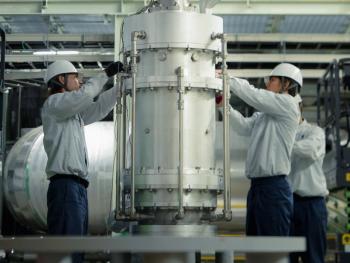
Ebara Elliott Energy enters liquid hydrogen aviation refueling, supplying a cryogenic pump for Chart Ferox’s GOLIAT trailer ahead of 2028 high-flow testing.
Siemens has manufactured replacement parts for an industrial steam turbine using additive manufacturing. The company is utilizing state-of-the-art AM technology to pave the way for greater agility in steam turbine component manufacturing and maintenance and to set new benchmarks for industrial power plant services.
Just last year, Siemens achieved another breakthrough by finishing its first full-load engine tests for gas turbine blades completely produced using AM technology. Now, after years of extensive research, development and testing, the company has extended its leadership in the use of AM in energy applications by producing a steam turbine replacement part with AM, reducing lead time by as much as 40 percent.
The 3D-printed parts are two oil sealing rings used in keeping oil separated from steam inside the steam turbine using pressurized air. The rings are being installed as replacement parts on the SST-300 industrial steam turbine operating at the JSW Steel Ltd. plant in Salem, India.
Siemens engineered, designed and developed the parts as part of a collaborative project between Siemens experts in Germany and India, as well as in Sweden, where the company operates a primary Additive Manufacturing center of expertise. Additive Manufacturing opened up new possibilities for making little changes with high impact in the design to further adapt the components to the client's challenging environment and needs. Siemens was able to add functional enhancements that could not have been made using a traditional manufacturing process.
Siemens has been investing in AM right from its inception, and is now driving the industrialization and commercialization of these processes. Additive Manufacturing is a process that builds parts layer-by-layer from sliced CAD models to form solid objects. This enables highly precise solutions to be formed from powdered high-performance materials. Siemens is a pioneer in AM and also uses the technology for rapid prototyping, manufacturing and advanced repairs.