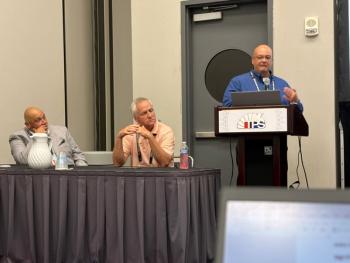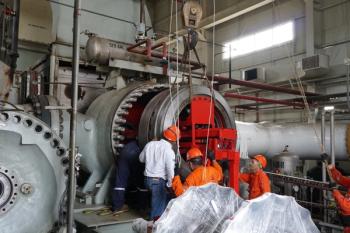
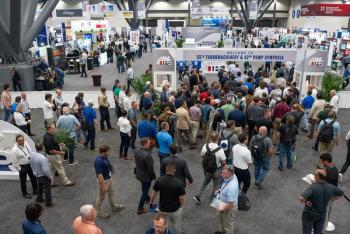
At the 2026 Turbomachinery and Pump Symposia, Engro Fertilizers’ Muhammad Uzair Javed explained how his team traced persistent high vibration to train misalignment, then moved a 100-ton turbine skid to cut vibration in half.
Accelleron’s Turbo SmartCare pact keeps Denton Energy Center’s gas peakers ready with condition-based monitoring that reduces outages and costs.
Accelleron has announced a five-year
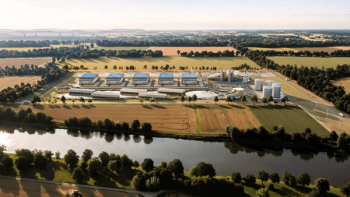
The DEC is a reciprocating natural gas-fueled power plant owned and operated by DME, the City of Denton's municipally owned electric utility. The facility is purpose-built for peak demand response and grid stability support—functions that have taken on heightened importance as Texas manages a diversifying generation portfolio that increasingly includes wind and solar.¹
Unlike combined-cycle or baseload plants, the DEC's reciprocating engine architecture allows individual generating units to be dispatched independently, enabling DME to modulate output within minutes in response to shifting grid conditions. This operational flexibility is a defining characteristic of peaking plants, and it has direct consequences for the mechanical demands placed on ancillary rotating equipment, including turbochargers.
Peaking plant turbochargers face a fundamentally different degradation profile than those operating in continuous-duty applications. Repeated thermal cycling during frequent starts and stops creates mechanical stresses—including differential thermal expansion, bearing load transients, and lubricant shear—that accelerate wear and increase the risk of unplanned failures if maintenance intervals are based on run hours alone.¹
According to Accelleron, the Turbo SmartCare agreement is specifically designed to address this challenge by aligning maintenance schedules with actual operating conditions rather than fixed intervals. The agreement covers field and workshop services, parts, travel, and wear-related components, providing DME with predictable cost structures and streamlined service execution across all 24 A175-M62 units.¹
The agreement incorporates continuous monitoring of turbocharger operating data to support equipment health assessment and early detection of potential issues. This data-driven approach enables proactive intervention before minor degradation escalates into forced outages—a critical capability for assets whose operational value is directly tied to availability during peak demand windows.¹
Lifecycle management is a central element of the agreement's structure. By tracking turbocharger performance trends over time and correlating them with the plant's specific dispatch history, Accelleron can optimize maintenance timing to minimize both cost and downtime across the five-year contract term.
Electricity demand in the United States is entering a new growth phase, driven by electrification, industrial expansion, and the rapid scaling of data center infrastructure. In Texas—home to the ERCOT grid, one of the most dynamic and supply-constrained electricity markets in North America—utilities are actively investing in flexible generation assets to manage increasing load variability.²
Reciprocating gas-engine plants occupy a strategically important position in this environment. Their fast-start capability and modular dispatch complement the intermittent output profile of wind and solar generation, providing the responsive capacity reserves that grid operators depend on during periods of system stress.¹
For turbomachinery and rotating equipment professionals, the Accelleron-DME agreement reflects a maturing understanding of how service strategy must evolve alongside plant operating profiles. As peaking assets cycle more frequently, the gap between run-hour-based maintenance programs and condition-aligned service agreements will increasingly translate into measurable differences in availability, lifecycle cost, and operational risk.