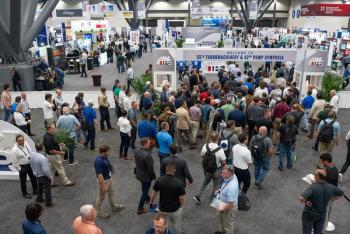
At the 2026 Turbomachinery and Pump Symposia, Opportune’s Dan Romito warned that grid constraints and a five-year gas turbine backlog are pushing AI data centers toward on-site power, while colleagues honored the legacy of the late Dara Childs.
The Louisiana Clean Energy Complex and NEOM Green Hydrogen Project will collectively supply hydrogen and ammonia for Yara International’s production and distribution network.
Air Products and Yara International ASA (Yara) will soon finalize a
“Air Products’ two advanced projects are a strategic fit with Yara’s nitrogen system—enabling energy diversification and profitable decarbonization while aligning with our disciplined capital allocation policy,” said Svein Tore Holsether, CEO, Yara. “The Louisiana project builds on a proven, capital-efficient model; producing ammonia from externally sourced hydrogen and delivering strong returns.”
In Louisiana, Air Products is developing the world’s largest
Air Products will retain ownership and operations for industrial gases production, supplying approximately 80% of the low-carbon hydrogen to Yara under a 25-year offtake agreement—this hydrogen will be used to produce 2.8 million tons of low-carbon ammonia per year. Remaining hydrogen volumes will be supplied to Air Products’ customers along the U.S. Gulf Coast via its 700-mile hydrogen pipeline system.
Additionally, about 5 million tons per year of high-purity CO2 captured at the Air Products facility will be sequestered by a third party according to a presently undisclosed long-term agreement. Both companies are targeting final investment decisions by mid-year 2026, with project completion slated for 2030.
The NEOM Green Hydrogen Project in Saudi Arabia is over 90% complete and may enter commercial production in 2027. Air Products is the sole offtaker of up to 1.2 million tons per year of renewable ammonia and may enter the following marketing and distribution agreement with Yara: The company will commercialize, on a commission basis, the ammonia not sold by Air Products as renewable hydrogen in Europe. The marketing and distribution contract is expected to be finalized by early 2026.
In August 2025, Air Products finished the first
Since 1957, Air Products and NASA have maintained a working relationship, with Air Products supplying liquid hydrogen and other industrial gases for Orion, the Space Shuttle, Apollo, and other U.S. Space Program applications, such as the Mercury missions. The company also works with NASA’s engine testing program at Stennis Space Center in Mississippi, Johnson Space Center in Texas, and the Marshall Space Flight Center in Alabama.