
Siemens Energy is rebranding as Omterra, unifying its gas turbine, compressor, and Siemens Gamesa wind portfolios under one corporate identity.
The ACES Delta project uses hydrogen production, salt cavern storage, and gas turbines to deliver dispatchable power to California while supporting long-term decarbonization goals.
The Greater Los Angeles area, falling under the broader Western Interconnect, is increasingly subject to energy curtailments as wind and solar power penetrate the grid. The limiting factors of variable generation opened the way for a project led by Chevron New Energies, Mitsubishi Power Americas, and the Intermountain Power Agency: the IPP Advanced Clean Energy Storage (ACES) Delta project.
At POWERGEN 2026, a session titled Bridging Innovation and Infrastructure with Hydrogen Power offered an in-depth review of the project’s progress, regional and international significance, and how it may be upscaled for future demand growth. The large-scale hydrogen power and storage project in Utah is demonstrating how existing coal infrastructure can be repurposed to support long-duration energy storage and grid decarbonization.
The IPP ACES Delta development is replacing a coal-fired plant in Delta, Utah, with a hydrogen-capable power system initially fueled by a blend of 70% LNG and 30% hydrogen. Project partners plan to transition to 100% hydrogen fuel by 2035, positioning the facility as a long-term clean energy resource for Los Angeles and surrounding regions. Green hydrogen for the project is produced using alkaline electrolysis and stored at the ACES site in permeable underground salt caverns. The hydrogen storage system is designed to provide long-duration energy storage and support grid reliability during periods of high demand or renewable intermittency.
Kevin Peng, Director of Power Capital Projects and External Generation at the Los Angeles Department of Water and Power, said the Intermountain Power Project uses hydrogen storage and repurposed coal assets to supply electricity to combined-cycle power units. The facility is connected to California through a 2,400-MW transmission line, integrating generation, transmission, and distribution into a single system that supports California’s decarbonization goals.
Bill Myers, Chief Operating Officer of ACES Delta at Chevron, said the project is part of Chevron New Energies, the company’s lower-carbon business unit. He said two single-shaft gas turbines have been installed at the site and are supplied by a one-mile fuel pipeline. The 220-MW hydrogen conversion facility and associated salt cavern storage are mechanically complete, with performance testing scheduled in the coming weeks.
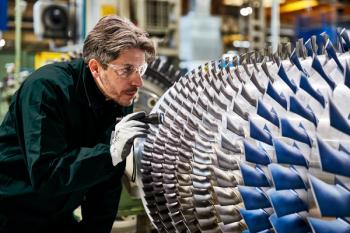
Ben Thomas, Director of Hydrogen Production at Mitsubishi Power Americas, said Mitsubishi supplied the project’s major equipment, including alkaline electrolyzers, M501JAC gas turbines, turbine control systems, and alternating- and direct-current transmission equipment. He said the turbines are capable of operating on hydrogen blends of up to 30% without modification.
The M501JAC gas turbines are currently operating and producing power commercially, with hydrogen blending and injection planned to begin in Q2 2026. He added that, in the near term, hydrogen is being deployed primarily as a long-duration energy storage medium rather than a full replacement for natural gas. All major equipment was validated before installation at the Takasago Hydrogen Park in Japan.
Thomas added that Mitsubishi Power is continuing development work on 100% hydrogen combustion in large-frame gas turbines and is also validating 100% ammonia combustion systems; however, broader commercialization of full hydrogen combustion will depend on the availability of sufficient hydrogen supplies. Additionally, IPP ACES Delta project received funding support from the U.S. Department of Energy and is expected to lower electricity costs for Los Angeles ratepayers by providing reliable, dispatchable clean power.
The excess energy stored in the salt caverns can be dispatched to ACES Delta when needed, helping balance supply and demand across the grid. The project demonstrates how hydrogen storage can support both renewable integration and long-term grid stability. Looking ahead, Myers said the site has significant expansion potential, with the ability to drill an additional 50 to 70 salt caverns, add electrolyzers, and scale storage and generation capacity to meet future power demand.
Per Myers, building a project of this scale has presented component-level and system integration challenges, requiring iterative testing and coordination. He emphasized that industry cooperation and transparency are critical for first-of-a-kind projects, particularly when integrating production, storage, and power generation systems. The session highlighted the role of hydrogen-enabled infrastructure in extending the value of existing assets while supporting long-term decarbonization objectives in the Western United States.