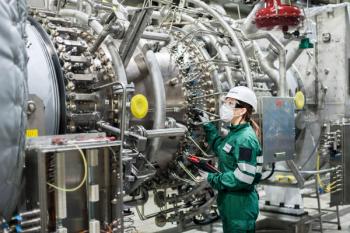

2025 orders hit a four-year high as gas turbine backlogs push data center developers toward a faster fix, but the rebound is landing just as one of the industry's largest OEMs explores selling the business behind it.
DOJ invokes national security to defend xAI’s unpermitted gas turbines for Grok, as NAACP Clean Air Act suit tests mobile vs stationary.
A lawsuit that began as a community air quality dispute in Southaven, Mississippi has become one of the most legally consequential cases in the brief but explosive history of behind-the-meter gas turbine deployment for AI data centers. The outcome could shape permitting practice for the turbomachinery industry for years to come.
The Department of Justice filed a motion in June in the U.S. District Court for the Northern District of Mississippi to intervene in a Clean Air Act lawsuit brought by the NAACP against xAI and its energy infrastructure subsidiary MZX Tech, seeking dismissal of the case on national security grounds.1 The DOJ's intervention followed a declaration from Cameron Stanley, the Department of Defense's Chief Digital and Artificial Intelligence Officer, that the gas-fired turbines at the center of the dispute power the Colossus 2 supercomputer, which is used to train and upgrade xAI's Grok AI models, including versions deployed by the Department of Defense.
"xAI's Grok represents one of only four proprietary state-of-the-art frontier AI currently capable of supporting national security applications," Stanley said in the court filing.1 He further revealed that Grok's integration into the Pentagon's Maven Smart System enabled U.S. forces to deploy over 2,000 munitions to 2,000 distinct targets within 96 hours during operations in the Iran conflict.1
The equipment in dispute is a fleet of Solar Turbines SMT-130 units—portable gas-fired industrial turbines, each affixed to a flatbed trailer—installed by xAI and MZX Tech at a site at 2875 Stanton Road South in Southaven, Mississippi, approximately one mile from the Colossus 2 data center across the Tennessee state line in South Memphis.
xAI installed 27 gas turbines at the Southaven site capable of generating up to 495 MW of power—the equivalent of a conventional power plant—without obtaining any air permits before installing or operating them. By May 2026, the fleet had grown further: instead of addressing its Clean Air Act violations, xAI added six more unpermitted gas turbines, bringing the total to 33 units with the potential to emit 2,508 tons of smog-forming nitrogen oxides annually—figures that likely make the facility the largest industrial source of NOx in the greater Memphis area, a region already failing to meet national smog standards.2
The Mississippi Department of Environmental Quality initially ruled that the turbines were exempt from stationary source permitting requirements because they are mobile, with each remaining affixed to a portable flatbed trailer.3 The NAACP, represented by Earthjustice and the Southern Environmental Law Center, has challenged that classification directly, citing manufacturer specifications for the Solar SMT-130 units: once installed, each unit stands 14 feet tall, runs nearly 100 feet long, and weighs more than 200,000 pounds.4 The Clean Air Act defines a stationary source as "any building, structure, facility, or installation which emits or may emit regulated air pollutants,” and the plaintiffs argue the scale and permanence of xAI's installation places it squarely within that definition.5
The xAI-Southaven dispute is not an isolated compliance failure. It is the first major legal test of a deployment model that has become increasingly common as AI data center developers race to secure power faster than grid interconnection timelines allow: the rapid installation of portable or modular gas turbines on or near data center sites, often in advance of—or in lieu of—formal air permitting.
The NOx emissions potential of xAI's turbine fleet likely makes the facility the largest industrial source of NOx in the 11-county Memphis metropolitan area, a claim that illustrates the regulatory exposure that can accumulate when behind-the-meter deployments at this scale proceed without the emissions controls that permitted stationary sources are required to install.3
For equipment suppliers, EPC contractors, and service providers active in the data center power generation market, the case highlights several near-term risk factors. First, the stationary versus mobile source classification question is unresolved at the federal level—a ruling against xAI could require retroactive permitting and emissions control retrofits across similar deployments industry-wide. Second, the DOJ's national security argument, while potentially effective in this instance, is unlikely to be available to most behind-the-meter operators and does not resolve the underlying permitting question. Third, the case signals that community opposition to gas turbine deployments near residential areas will increasingly find legal expression through Clean Air Act citizen suit provisions, which is a litigation pathway that does not require EPA action to proceed.
The turbomachinery industry has long understood that emissions compliance and community relations are not afterthoughts. The xAI case is a high-profile reminder that in the Gigawatt Era, the speed of deployment and the discipline of permitting must advance together.