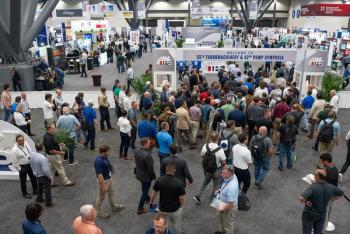
At the 2026 Turbomachinery and Pump Symposia, Opportune’s Dan Romito warned that grid constraints and a five-year gas turbine backlog are pushing AI data centers toward on-site power, while colleagues honored the legacy of the late Dara Childs.
Before commercial availability, the CR2.2 injectors were successfully field-tested for over 12,000 operating hours on an Everllence 48/60CR engine and confirmed high reliability.
Everllence recently announced that its medium-speed, common-rail (CR) technology has exceeded a cumulative total of
The CR2.2 was integrated with Everllence’s 49/60DF engine in September 2024, and, before commercial availability, the injectors were successfully field-tested for over 12,000 operating hours on a 48/60CR engine and confirmed high component reliability. Per Everllence, the first 32/44CR engine prototype is currently being prepared for an initial test run using the new CR2.2 generation.
“20 million operating hours is a notable achievement that is born from 18 years of experience in the field involving over 600 engines, 5,500 cylinders, and across a broad range of applications and fuels,” said Michael Filous, Senior Vice President and Head of PrimeServ Germany, Everllence. “We recently brought production completely in-house, a key move that simplified the technical side of things. Everllence’s common-rail system is essentially a proven, modular system that easily adapts to different engine sizes.”
Compared to the CR1.6 generation, the CR2.2 offers up to 38% increased rail pressure across all applications (2,200 bar) and more than 33% longer time-between-overhaul intervals for most components. Additionally, the technology features 35% fewer high-pressure connections, reducing leakage risk and improving serviceability. It’s a platform for a wide range of fuels, including alternative sources like HVO and FAME.
Last week, COSCO Shipping Lines ordered Everllence’s B&W 8G95ME-GI Mk. 10.5 main engine, marking the company’s
Everllence’s dual-fuel strategy and technology enabled many oceangoing ships to operate with alternative low-emissions fuels, showcasing environmentally friendly and reliable propulsion in the marine industry. The two-stroke engines can switch between fuels with minimal effort.
According to the company, more than half of its order book features dual-fuel engine power. The 2,000-engine figure is a cumulative total for all engine orders from the company’s two-stroke portfolio that includes ME-GI (methane), ME-LGIM (methanol), ME-GIE (ethane), ME-LGIP (LPG), and the recently announced ME-LGIA (ammonia) engines.
In November 2025, Everllence launched its new, dual-fuel
The engine’s digital connectivity provides secure and reliable data flow from maritime vessels to Everllence shore-based monitoring, allowing the use of real-time engine and operational data to enhance performance, deliver remote assistance, and help shipowners operate more efficiently and sustainably. Data-driven insights will support decarbonization as new fuels, like ammonia, permeate the market.