
News|Articles|June 18, 2026
GE Vernova's 2025 Sustainability Report Shines a Light on New Power, Emissions Reductions
Author(s)Alicia Bigica
Listen
0:00 / 0:00
Key Takeaways
- New equipment additions totaled 26 GW, and associated avoided emissions reached 22 MtCO₂, while delivered capacity carbon intensity was ~31% below the global average grid baseline.
- Alternative-fuel readiness advanced with a validated hydrogen DLN combustor for B- and E-class turbines, enabling stable blends through 100% H₂ and sub-25 ppm NOx dry emissions.
GE Vernova’s 2025 sustainability results highlight major emissions cuts, 26 GW new capacity, hydrogen/ammonia turbine progress, SMR licensing, CCS buildout, and grid upgrades.
Advertisement
GE Vernova's 2025 Sustainability Report reveals the company brought 26 GW of new generating capacity online last year—roughly equivalent to the entire installed generation base of Louisiana—while achieving a 64% cumulative reduction in Scope 1 and 2 operational emissions since 2019.¹ For professionals in turbomachinery and rotating equipment, the report's technical disclosures on hydrogen combustion, ammonia fuel testing, small modular reactors (SMRs), and carbon capture infrastructure are particularly significant.
What Did GE Vernova Achieve on Decarbonization in 2025?
According to the report, new generating capacity brought online by GE Vernova equipment carried a carbon intensity approximately 31% below the global average carbon intensity of the existing grid.¹ The company also reported 22 million metric tons of CO₂ avoided in 2025 through deployment of lower-carbon technologies—equivalent to removing 5.1 million gasoline-powered passenger vehicles from the road for a year.¹
Year-over-year, GE Vernova reduced its Scope 1 and 2 (market-based) greenhouse gas emissions by 27% across operations, building toward a 64% total reduction since its 2019 baseline.¹
Where Does Hydrogen and Ammonia Combustion Stand?
The report's most actionable data for gas turbine engineers concerns alternative fuel readiness. GE Vernova confirmed it successfully completed the validation test campaign of a hydrogen Dry Low NOx (DLN) combustor for B- and E-class gas turbines, demonstrating stable operations on natural gas/hydrogen blends and on 100% hydrogen—with dry emissions below 25 ppm NOx.¹
On ammonia, GE Vernova and IHI completed commissioning of a new Large-scale Combustion Test (LCT) facility engineered to test advanced ammonia combustion systems at F-class gas turbine operating conditions.¹ These milestones are closely watched across the industry, as ammonia and hydrogen co-firing represent critical pathways for reducing the carbon intensity of combined-cycle power plants without wholesale equipment replacement. Industry analysts tracking the energy transition have noted that demonstration of sub-25 ppm NOx performance on 100% hydrogen is a significant technical threshold for practical deployment.²
What Is the Status of GE Vernova's SMR and CCS Programs?
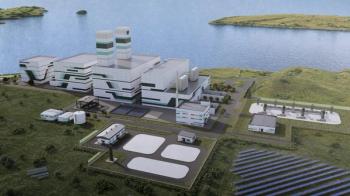
Two large-scale infrastructure milestones were highlighted in the report. In April 2025, GE Vernova Hitachi received the first license issued to construct an SMR in Canada, with construction of the BWRX-300 at Ontario Power Generation's Darlington site beginning in May 2025. The project is positioned to deliver the first operating commercial SMR in the Western world.¹
On carbon capture, construction began in 2025 on the Net Zero Teesside (NZT) Power station in the United Kingdom—designed to be the world's first commercial-scale gas power plant equipped with CCS. The facility is expected to generate more than 740 MW of lower-carbon power once operational.¹
How Is GE Vernova Addressing Grid Infrastructure?
Beyond generation assets, the report noted that 68 GW of new power transformers were energized in 2025—equivalent to the approximate installed generating capacity of Egypt—with 33% deployed in developing and emerging economies.¹ Grid infrastructure expansion at this scale directly affects system stability for large rotating equipment, influencing protection schemes and interconnection standards for turbines operating in regions with rapidly growing load.
What Does the Circularity Data Mean for Equipment Lifecycle Management?
GE Vernova reported that 53% of its top products are now covered under its 4R circularity framework (Rethink, Reduce, Reuse, Recycle), up from 38% in 2024.¹ Additionally, 76% of products are now covered by Life Cycle Assessments (LCAs) or Environmental Product Declarations (EPDs)—data increasingly required by asset owners and utilities managing decarbonization commitments across the full equipment lifecycle.
GE Vernova's full
References
1. GE Vernova. GE Vernova Releases 2025 Sustainability Report. Press release; June 17, 2026.
2. GE Vernova. *GE Vernova Sustainability Reports & Data*.
Advertisement
Related Content
Advertisement


Advertisement
Advertisement