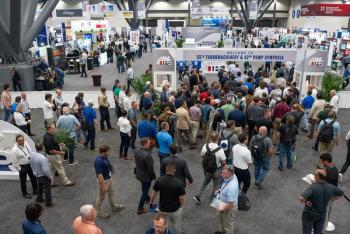
At the 2026 Turbomachinery and Pump Symposia, Opportune’s Dan Romito warned that grid constraints and a five-year gas turbine backlog are pushing AI data centers toward on-site power, while colleagues honored the legacy of the late Dara Childs.
The floating storage and regasification unit will supply up to 1,000 mmscf/day of LNG regasification capacity in Egypt, while its predecessor is shipped to Australia.
Höegh Evi and the Egyptian Natural Gas Holding Co. (EGAS) entered a 10-year time charter agreement to convert the Hoegh Gandria LNG carrier to a floating storage and regasification unit (FSRU) and deploy the vessel at Egypt’s Port of Sumed. Set to deploy in Q4 2026, the FSRU Hoegh Gandria will deliver up to 1,000 mmscf/day of peak LNG regasification capacity.
"Höegh Evi is proud of our longstanding role as a trusted energy infrastructure partner to Egypt and we are excited to begin the conversion of Hoegh Gandria to a floating import terminal, highlighting the unique flexibility of marine infrastructure,” said Erik Nyheim, President and CEO of Höegh Evi. “We look forward to building on the long relationship we have with EGAS and supporting the growth of Egypt's diversified energy system."
Prior to full FSRU conversion and to accelerate the deployment process, Höegh Evi will convert the Hoegh Gandria to a floating regasification and import terminal. Following this transformation, the company will begin the full-scale project immediately to ensure on-time delivery to EGAS. The FSRU Hoegh Gandria will replace a vessel deployed in Egypt in July 2024, the Hoegh Galleon.
The Hoegh Galleon was signed over to Australian Industrial Energy via interim charter and will remain in Egypt for up to one year before departing to an LNG terminal in Port Kembla, Australia, in 2027. The Hoegh Gandria was acquired in February 2023 for this conversion project, which allows Egypt to diversify its flexible marine-energy infrastructure.
EGAS in the News
In May 2024, QatarEnergy signed a joint venture agreement with ExxonMobil to purchase a 40% participating interest in two
Energy in Egypt
In early January 2025, Rolls-Royce installed, tested, and verified
The production plant avoids burning rice straw—a byproduct of rice cultivation—by repurposing straw into MDF. The rice straw replaces wood as a raw material in MDF, which is used to make cabinets, doors, furniture and commercial and residential buildings. It is the second plant of its kind globally and the first in Africa, notably minimizing air pollution and CO2 emissions in Egypt.
The company partnered with Engineering for Industries Co. and the Egyptian Maintenance Company to provide the gensets, controls, and related accessories for the WOTECH project, founded and supported by capital from Egypt’s petroleum ministry.