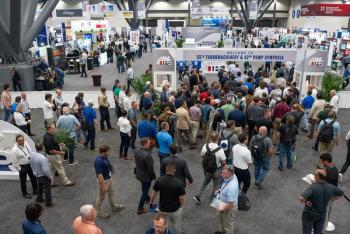
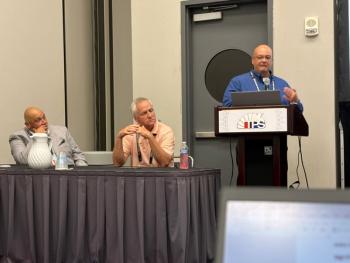
At the 2026 Turbomachinery and Pump Symposia, John Crane’s Brian Kalfrin explained why volatile natural gas liquids demand custom-engineered seals, from face material selection to installation and flush rates.
The filtration sieves can endure extreme vibration, pressure, and temperature variations during launch and space travel, supporting the spacecraft’s propellant management devices.
John Crane and other Smiths Group businesses will deliver various technologies to support NASA’s
“Every piece of equipment for this kind of spacecraft needs to undergo a demanding qualification and acceptance program,” said Dr. Nicolas Fries, Orion Propellant Tank Development Lead at ArianeGroup. “During the sieve development phase, we had to combine the extensive sieve manufacturing expertise from John Crane with the space engineering know how of ArianeGroup. John Crane has proven to be a reliable supplier for such critical elements, and we are looking forward to continuing our cooperation.”
The filtration sieves are designed to endure extreme vibration, pressure, and temperature variations during launch and space travel; therefore, the technology is manufactured to significantly high specifications. Additional Smiths Group businesses are supporting key systems aboard the Artemis II mission:
NASA’s Artemis II mission will transport four astronauts around the Moon on the Orion spacecraft and represents the first crewed lunar mission since Apollo, marking a return to humanity’s deep space exploration. The component delivery reflects John Crane’s expertise in precision-engineered solutions for demanding, safety-critical applications.
“Artemis II is an example of what’s possible when engineering expertise, innovation, and collaboration come together,” said Ruben Alvarez, President of John Crane. “At John Crane, we are proud to contribute specialized technologies alongside our colleagues across Smiths Group, helping to enable a mission that pushes the boundaries of performance, reliability, and human exploration.”
In December 2025, John Crane signed a multi-year
The agreement offers the customer a consistent reliability model across all participating sites and aligns with a plan to streamline supplier engagement and bolster global reliability governance across its asset portfolio. Also, it blazes a pathway for expanded dry gas seal support, improved lifecycle optimization, and broader reliability improvements in multiple regions.
A unified approach provides multiple benefits, such as improved operational reliability and uptime driven by the consistent application of methodologies; proactive failure prevention supported by organized lifecycle programs and technical governance; reduced complexity via the consolidation of sealing and service expertise; strengthened compliance with international standards like API and wider industry guidance; and efficient long-term planning enabled by synchronized service delivery and predictable technical support.