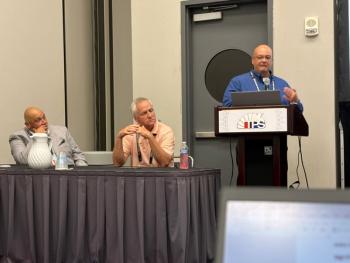
At the 2026 Turbomachinery and Pump Symposia, Opportune’s Dan Romito warned that grid constraints and a five-year gas turbine backlog are pushing AI data centers toward on-site power, while colleagues honored the legacy of the late Dara Childs.
DOE coal funding targets coal plant modernization and coal recommissioning, driving steam turbine upgrades, turbomachinery work, and grid reliability amid AI data center power demand.
The U.S. Department of Energy (DOE) announced on June 4 the selection of four projects under its "Restoring Reliability: Coal Recommissioning and Modernization" initiative, committing up to $350 million to build, retrofit, and recommission
The announcement is part of a broader $525 million DOE commitment to coal infrastructure, which includes $175 million already allocated to six previously announced modernization projects at operating plants across Indiana, Kentucky, North Carolina, North Dakota, Oklahoma, Tennessee, West Virginia, and Wisconsin.2
The four projects span new construction, full modernization, and recommissioning:
If the Anchorage and Mt. Storm plants proceed to commercial operation, they would be the first new coal-fired power plants built in the United States since 2013.3
The engineering detail released by DOE on the previously awarded modernization projects—the six plants receiving $175 million—reveals significant rotating equipment and emissions control work that sits squarely within the turbomachinery industry's domain.
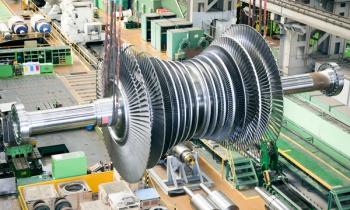
At one project site, detailed project selections published by DOE describe a comprehensive modernization scope across two 590 MW units: turbine rotor replacements on both units to restore reliability, generator refurbishments, boiler component replacements, selective catalytic reduction (SCR) catalyst replacements, and flue gas desulfurization (FGD) equipment refurbishments—with the full program of work scheduled across a four-year period from 2027 to 2030.4
At the Mountaineer plant, DOE project documentation describes the restoration of the pendant reheater to its original design configuration to recover intended reheat outlet temperature—a modification that is projected to increase turbine efficiency and reduce environmental impact through improved fuel utilization. The plant's electrostatic precipitator system is also slated for full modernization in 2027.4
DOE's Transformative Power Systems program, which underpins the technical framework for these upgrades, identifies turbine and boiler improvements as the primary levers for efficiency and reliability gains, with R&D priorities including increased steam temperature and pressure, sliding pressure upgrades, and digital monitoring with AI-based analysis.5
The policy context is explicit. U.S. Energy Secretary Chris Wright framed the investment in terms of grid reliability and energy affordability: "Unfortunately, previous leaders launched relentless attacks on U.S. coal workers and industry, threatening grid reliability and driving energy prices higher for the American people. Thanks to President Trump, we are not only stopping the premature closure of our coal plants, but also taking steps to expand and modernize existing coal infrastructure."1
The underlying demand driver, however, is the same force reshaping turbomachinery markets broadly: AI data center load growth. Electricity demand from data centers is projected to exceed 1,000 TWh globally by the end of 2026, and the U.S. grid—much of which was built between the 1950s and 1970s—is under increasing strain to deliver dispatchable baseload capacity at the scale and speed hyperscalers require.6
Coal's appeal in this context is its dispatchability. Unlike intermittent renewable generation, coal plants—like gas turbines—can be dispatched on demand, provide inertia to the grid, and operate at consistent output levels regardless of weather conditions. Recommissioning a shuttered plant or extending the life of an existing one delivers capacity faster than most greenfield alternatives.
Not all four projects face equal paths to execution. The Anchorage plant, while technically and economically evaluated by DOE, reportedly still lacks final design and cost detail, permits, and signed utility power purchase agreements. Analysts have also noted that needed support infrastructure for the Anchorage project could approach $1 billion in total cost beyond the DOE grant.3
More broadly, no new coal-fired power plant has been commissioned in the U.S. for over a decade. Capital markets, insurance underwriters, and equipment supply chains that once served the coal sector have significantly contracted, raising execution risk for greenfield development that extends beyond the funding commitment itself.
For turbomachinery professionals, the immediate implications are concentrated in two areas.
The first is the modernization pipeline. The $525 million in total DOE commitment—combined with the requirement for substantial non-federal cost-share on most projects—represents a meaningful wave of steam turbine, boiler, and emissions control work at existing plants. Turbine rotor replacements, SCR catalyst upgrades, and reheater restorations of the type detailed in DOE project documentation are well-understood scopes for the industry's OEM service divisions and independent MRO providers.
The second is the broader grid reliability signal. The simultaneous pressure on gas turbine OEM backlogs—now stretching to five or more years for heavy-duty units—and the renewed investment in coal modernization both reflect the same underlying reality: dispatchable baseload power is in short supply relative to what AI-driven load growth demands, and every available technology pathway to deliver it is being pursued in parallel.
Turbomachinery International will continue tracking the progress of these projects as permitting, engineering, and procurement phases develop.