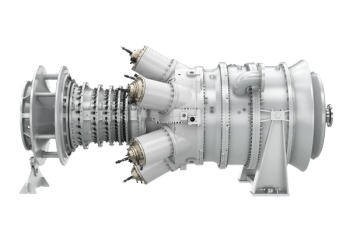

Siemens Energy's Gas Services orders surged 62% to a record as the company joined GE Vernova and Baker Hughes in reporting a record turbomachinery quarter.
The collaborative effort aims to capture 1.1 million tons of CO2 per year under GO4ZERO, Holcim’s investment program focused on achieving carbon neutrality in Belgium by 2030.
Air Liquide and Holcim entered an agreement to develop a
The new strategic agreement aims to transform Holcim’s Obourg plant into a leading large-scale near-zero cement production facility, representing a milestone for the collaborative project. Its final investment decision is subject to additional partnerships across the value chain, as well as public sector support for infrastructure regulation and the provision of derisking mechanisms.
“The transition toward a low-carbon industry is a long-term endeavor that requires steady collaboration and public support in its initial phase,” said Émilie Mouren-Renouard, Member of Air Liquide’s Executive Committee. “For many years, Air Liquide has been committed to decarbonize industrial sectors such as the cement industry, with the development of its advanced carbon-capture technologies. Alongside our partner Holcim, we share the same ambition and this new milestone agreement for the GO4ZERO project is a signal for Belgium’s industrial decarbonization and energy transition.”
This project aims to capture 1.1 million tons of CO2 per year under GO4ZERO, Holcim’s investment program focused on achieving carbon neutrality in Belgium by 2030. The initiative would significantly contribute to the European Union’s 2050 net-zero target. This partnership demonstrates the Air Liquide Group’s ability to provide efficient carbon-capture solutions at scale to meet the needs of its customers.
In December 2025, per a contract extension with Yanchang Petroleum Group, Air Liquide agreed to invest approximately €25 million to revamp its
The total annual CO2 emissions reduction will reach 550,000 tons per year, primarily by leveraging low-carbon energy sourcing throughout the plant’s lifecycle. The electricity-powered production unit is expected to commence operation by year-end 2027. Before then, Air Liquide will continue to execute services and supply gas to the Yanchang Group’s subsidiary, Kaiyue.
The contract was signed in Beijing during Emmanuel Macron’s visit, contributing to China’s 2030/2060 carbon peaking and carbon neutrality goals, respectively. This project reflects Air Liquide’s global decarbonization strategy, as the company previously electrified two oxygen facilities in Tianjin. In 2008, Air Liquide began a long-term partnership with the Yanchang Group by supplying gas to Kaiyue.
In mid-November 2025, Air Liquide successfully kickstarted the world’s first