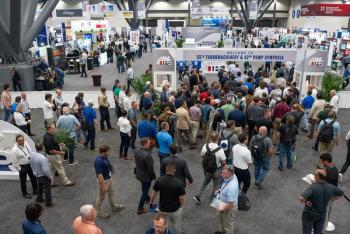
At the 2026 Turbomachinery and Pump Symposia, Opportune’s Dan Romito warned that grid constraints and a five-year gas turbine backlog are pushing AI data centers toward on-site power, while colleagues honored the legacy of the late Dara Childs.
Texas hybrid plant pairs HA gas turbines with BWRX-300 SMRs, using modular builds to deliver fast baseload power for data centers.
Blue Energy and GE Vernova Hitachi Nuclear Energy (GVH) have signed a new agreement to advance engineering, licensing, and safety analysis for a 2.5 gigawatt combined gas-and-nuclear power plant in Victoria, Texas — a project that pairs GE Vernova's 7HA.02 gas turbines with GVH's BWRX-300 small modular reactors (SMRs) in what the companies describe as a blueprint for scalable baseload power deployment.¹
The deal, announced Aug. 13, moves the project into its next development phase, targeting a final investment decision in 2027.¹ Under the current plan, Blue Energy will bring approximately 1 GW online initially using two GE Vernova 7HA.02 gas turbines by 2030 to serve a nearby data center load. Up to five BWRX-300 SMRs would then add a further 1.5 GW beginning in 2032, bringing the project's total generating capacity to 2.5 GW.¹
The gas-first, nuclear-follow sequencing is a deliberate strategy: fast-to-deploy gas turbine capacity establishes an early revenue stream and grid connection while the SMR units — which carry longer lead times for licensing and construction — are brought online in parallel.
GE Vernova's 7HA.02 is a well-established frame in the heavy-duty gas turbine market, known for high combined-cycle efficiency and operational flexibility. Its selection here reflects a broader industry pattern of using proven turbomachinery as an anchor technology in hybrid generation schemes.
The BWRX-300, a 300 MWe boiling water SMR developed by GVH, is designed around significant passive safety simplifications relative to conventional BWR designs. The first BWRX-300 unit is currently under construction at Ontario Power Generation's Darlington site in Canada, with grid commissioning expected before the end of the decade — a milestone that would make it the first grid-scale SMR to operate in the Western world.¹
For turbomachinery professionals, the integration of large-frame gas turbines with SMR steam cycles in a single-site architecture raises meaningful engineering considerations around shared balance-of-plant infrastructure, thermal dispatch sequencing, and grid interconnection design — areas where rotating equipment expertise is directly applicable.
Central to Blue Energy's cost reduction thesis is what the company calls the "Blue Way" — a proprietary approach to offsite prefabrication, modular assembly, and logistics designed to improve schedule certainty and reduce capital costs.¹ Founded in 2023 and rooted in MIT's Nuclear Science and Engineering Department, the company is backed by VXI Capital, Engine Ventures, At One Ventures, and Tamarack Global.¹
"We are shifting from the old way of building large reactor nuclear power to instead do it the 'Blue Way' that slashes costs and time to power and finally makes nuclear a financeable, repeatable product," said Jake Jurewicz, Blue Energy CEO and co-founder.¹
The approach mirrors prefabrication strategies that have gained traction in offshore oil and gas and liquefied natural gas plant construction, where modular, shop-fabricated assemblies have demonstrably improved cost and schedule outcomes compared to field-built approaches.
The Victoria project reflects a broader industry shift toward hybrid generation portfolios designed to address the intermittency limitations of renewables while meeting the sustained baseload demand now being driven by AI data centers and advanced manufacturing. GE Vernova Power segment CEO Eric Gray framed the collaboration in those terms, describing it as combining "GE Vernova's flagship HA gas turbine technology with GE Vernova Hitachi's advanced nuclear SMR technology" to deliver "reliable baseload power at the scale and speed customers need."¹
For rotating equipment engineers and project developers, the project offers an early look at how gas turbine and nuclear steam systems may be integrated at scale — and how modular construction methodologies being refined in the SMR space could eventually inform practices across the broader power plant construction sector.