At the 2026 Turbomachinery and Pump Symposia, John Crane’s Brian Kalfrin explained why volatile natural gas liquids demand custom-engineered seals, from face material selection to installation and flush rates.
At the 2026 Turbomachinery and Pump Symposia, Engro Fertilizers’ Muhammad Uzair Javed explained how his team traced persistent high vibration to train misalignment, then moved a 100-ton turbine skid to cut vibration in half.
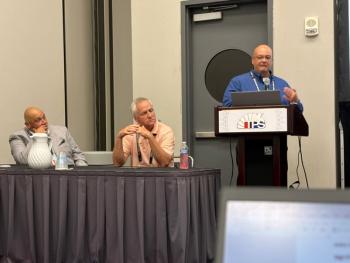
Day three of late September’s Turbomachinery and Pump Symposia (TPS) in Houston featured a packed morning of case studies covering every aspect of turbomachinery and pump maintenance. One of the highlights this year was a presentation by Muhammad Uzair Javed, senior rotating machinery engineer at Engro Fertilizers of Pakistan. The presentation concerned problems with a GE MS5001PA Frame 5 unit rated at 25.1 MW.
The turbine suffered chronic high vibration at the high-speed shaft drive end. Vibration diagnostics indicated probable misalignment between the gas turbine and gearbox. During a recent major turnaround, a comprehensive alignment correction was executed. Javed covered the diagnostic methods employed, how the root cause analysis was done, the difficult work of moving the turbine skid and the results achieved from corrective actions on this legacy Frame 5 unit.
Commissioned in 2009, the turbine operates within a urea ammonia complex. One minor alignment correction was carried out in 2012. Beginning in 2019, further misalignment was observed. It progressively worsened, leading to elevated vibration levels in 2023 based on major inspection data.
Further investigation revealed that vibration levels on the machine itself were within an acceptable range according to OEM specifications. The only exception was the gearbox. High vibration on the high-speed shaft drive end was apparent during steady-state operation.
Because the gearbox had been installed in 2022, the initial view was that it might be the problem. This was found not to be the case. Similarly, bearing inspection did not reveal any issues there. It became clear that misalignment was the primary issue. Misalignment troubleshooting discovered an unusual elliptical orbit indicating mechanical constraint at the coupling.
A long enough outage window in 2024 afforded enough time to complete the necessary work. Even then, the repair took 10 days of 24/7 action.
“Once we decided to attempt complete train alignment correction, the first step was to select a skid that could be moved between the generator skid and the turbine skid,” Javed said.
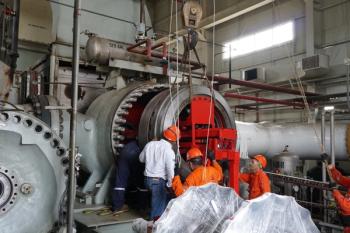
Based on the original drawings and inspection of the skids, movement of the generator skid was ruled out. The turbine skid was the easier (yet highly problematic) option. That skid weighed 100 tons.
To make the work possible, personnel carried out field modifications such as removal of walking platforms, small-bore piping and cable trays.
The history of drifting alignment was reviewed before work commenced. Engineers noted a trend of the turbine slowly moving lower than the generator. This uncovered the fact that the turbine alignment bolts were not fitted and torqued according to specifications. This was a primary cause of lateral misalignment. In addition, foundation settlement was apparent. Measurement of clearances also found that one bolt was pressing the turbine casing, adding to the situation. To move the skid at all, personnel had to add grease to the ground.
“Conducting alignment corrections to achieve OEM specification proved to be a troublesome task,” Javed said. “However, we managed to reduce vibration from 80 microns to 40 microns, which moved it into an acceptable range.”
Based on the success of the work in reducing vibration levels and stabilizing machine behavior, Javed validated his conclusion that persistent high vibration at the high-speed shaft drive end was linked to longstanding train misalignment rather than bearing or gearbox defects.
“Correcting OEM-defined lateral restraints was critical to the achievement of better alignment,” Javed said.