At the 2026 Turbomachinery and Pump Symposia, Engro Fertilizers’ Muhammad Uzair Javed explained how his team traced persistent high vibration to train misalignment, then moved a 100-ton turbine skid to cut vibration in half.
At the 2026 Turbomachinery and Pump Symposia, Opportune’s Dan Romito warned that grid constraints and a five-year gas turbine backlog are pushing AI data centers toward on-site power, while colleagues honored the legacy of the late Dara Childs.
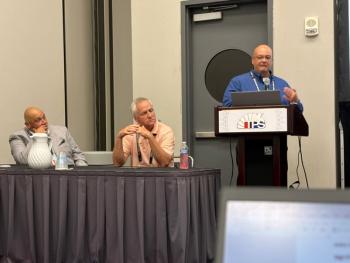
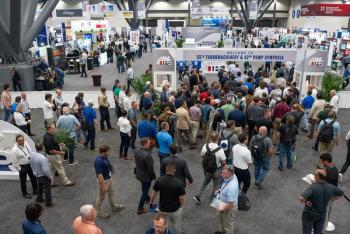
Day two of the Turbomachinery and Pump Symposia (TPS) featured a packed day of sessions and a buzzing exhibition floor. Big topics included AI data centers, concerns about the extent of the gas turbine backlog and a tribute to a turbomachinery legend.
Dan Romito, managing director of the sustainability practice at consulting and investment banking firm Opportune, contrasted the amount of power being requested by AI data centers and other large industrial users with how much power the grid is capable of delivering for new mega-loads.
“We can’t rely on the grid to provide the volume of gigawatts of power that has been announced by AI data centers and others of late,” he said. “The amount of that power that will eventually become energized will be considerably less.”
The modern grid, he added, must deal with problems and applications it has never dealt with before — hyperscale data centers, AI workloads, electric vehicles, rooftop solar and an abundance of digital devices in every household. Now factor in that 70% of the U.S. transmission infrastructure and transformers are more than 25 years old and that 80% of power outages since 2000 stem from severe weather.
“35 GW of new power is needed to meet demand, yet regulatory uncertainty makes progress difficult,” Romito said. “Without permitting reform, we won’t be able to move fast enough to modernize the grid.”
A gas turbine backlog of 260 weeks, according to Romito, adds to the problem. That’s around twice as long now as the lead times for transformers, which are notorious for their lengthy delivery times. Lack of skilled labor, particularly electricians and plumbers, further contributes to delays in building power plants and AI data centers.
Romito labeled the grid an obsolete dinosaur. He advocates on-site power as the way forward.
“Dedicated behind-the-meter power arrangements can change key dependencies and provide more control over project timelines,” he said. “Developers are sick and tired of waiting around on the bureaucracy to approve facilities.”
The highlight of the second day of the show was a session to honor the technical legacy of Dr. Dara Childs. He led the Turbomachinery Laboratory at Texas A&M University for 34 years (1984 to 2018). He was also the long-term chair of the Turbomachinery and Pump Advisory Committees that organize the technical program for the annual TPS event.
A series of colleagues, former students and fellow researchers outlined his career and achievements. It began at NASA’s American Society for Engineering Education (ASEE) program, which helped develop the space shuttle’s main engine. That was followed by a contract with NASA’s Marshall Space Flight Center to analyze the vibration characteristics of the high-pressure oxygen and fuel turbo pumps of the engine.
Childs zeroed in on the fluid forces present inside seals, basing his research on earlier work by Scotsman Henry Black. That led to the creation of a model of many fluid forces highlighting that the space shuttle’s hydrogen pump would become unstable and eventually inoperable.
NASA didn’t pay too much attention to his findings. Several months later, the agency called him with the news that instability within the space shuttle’s main engine was even worse than he predicted. NASA agreed to fund his research, which took place at Texas A&M University where he established the Turbomachinery Laboratory.
Childs went on to co-found the Turbomachinery Research Consortium (TRC) of turbomachinery developers, vendors and users. Its purpose? To discover answers to questions about turbomachinery performance and reliability. The TRC sponsors Texas A&M Turbo Lab graduate students annually.
Dr. Luis San Andrés, professor of mechanical engineering at Texas A&M, detailed Childs’ path of research, discovery and achievement in bearing technology, particularly hydrostatic bearings for reusable rocket engines. Early versions of these bearings were expensive and short-lived. This research occasioned a transition from ball bearings to fluid film-based hydrostatic bearings as a possible way to provide stiffness and damping for liquid hydrogen and oxygen turbo pumps. Through a series of testing rigs, areas such as pivot flexibility and accurate clearance measurements were found to be critical for predictive modeling.
Over the next hour, several more of his colleagues and former Ph.D. students detailed his many achievements in fluid modeling. Jeff Moore, a researcher at Southwest Research Institute, covered Childs’ work on the influence of rotor-fluid interaction on impellers and his development of a flow model for seals and pump impellers. This model incorporated Coriolis and centrifugal acceleration forces.
“I conducted detailed computational fluid dynamics (CFD) analysis on these phenomena, which thoroughly validated Dr. Childs’ earlier models,” Moore said. “While most models deal with one or two factors, the models he developed encompassed a great many factors including the eye seal, interstage seal, and front and back shroud of a centrifugal compressor impeller.”
Further speakers summarized his foundational work in transient rotor response, force and torque balance equations in different rotor sections, tilting-pad journal bearing studies, testing rigs to validate research hypotheses and rotor dynamics modeling. Dr. Childs died in 2024.