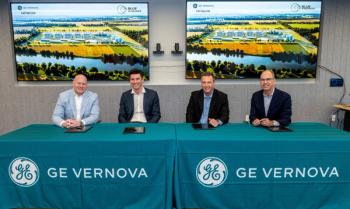
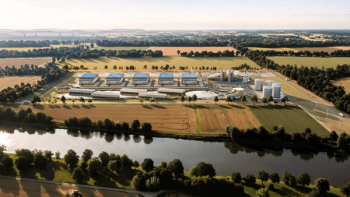
The Port of Victoria project would be only the second U.S. project to pursue NRC construction licensing for the GE Vernova Hitachi Nuclear Energy boiling water SMR design.
GE Vernova will perform rotor life extension work on five 9F gas turbines in Egypt, adding 13 to 15 years of life to about 1,250 MW of capacity.
GE Vernova has signed a services agreement to perform rotor life extension (RLE) work on five 9F gas turbines at the Kureimat, Nubaria, and Cairo North power plants in Egypt, according to a press release from the company dated Sept. 23, 2026.1 The work is expected to add 13 to 15 years of operating life to units totaling about 1,250 MW, and it will be executed between 2028 and 2035. The company said the order was booked in the second quarter of 2026.1
The agreement was signed with three generation affiliates of the state-owned Egyptian Electricity Holding Company (EEHC): Upper Egypt Electricity Production Company (UEEPC), Middle Delta Electricity Production Company (MDEPC), and Cairo Electricity Production Company (CEPC). EEHC endorsed the deal.1
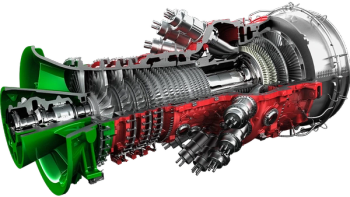
The rotor is one of the most consequential components in a heavy-duty gas turbine's maintenance plan, according to the release from GE Vernova.1 Hot gas path parts are routinely repaired or replaced at scheduled inspections, but the rotor assembly is typically managed against a finite life defined by accumulated fired hours and starts. As units approach that limit, owners have three choices: replace the rotor, retire the unit, or establish whether the existing hardware can safely stay in service.
RLE programs address that last option. GE Vernova said the Egyptian project will draw on its engineering expertise to determine the full residual life of rotor components, with the goal of keeping them operating efficiently and effectively.1 Such programs generally combine detailed inspection and nondestructive evaluation with engineering analysis. That work establishes how much additional service the rotor can support and which parts need refurbishment or replacement. The 2028–2035 execution window also gives the three generation companies time to plan the work around scheduled outages at each site.1
For owners, the payoff is avoiding the cost and extended outage of a full replacement. Eng. Mahmoud Al-Naqeeb, EEHC's full-time board member for electricity production companies affairs, said life extension is expected to support grid stability and the continued availability of dispatchable power, "while helping us increase the value of existing infrastructure and avoid premature, capital-intensive replacement."1
Egypt's power sector is in the midst of a significant transformation.1 The five units belong to a thermal fleet that remains central to the country's electricity supply. Thermal generation, led by combined-cycle gas turbine plants, accounts for approximately 80% of Egypt's electricity production. The country also faces rapidly rising demand and is working to integrate a growing share of renewables. Both trends raise the value of dispatchable gas capacity that can balance variable wind and solar output.
"This agreement reflects EEHC's continued focus on preserving the long-term performance and reliability of important generation assets across our fleet," said Eng. Gaber El-Desouki, chairman and CEO of EEHC.1 He described the agreement as a practical, proactive step to protect strategic assets and support efficient, reliable power production in line with Egypt's broader energy objectives.
Joseph Anis, president and CEO for Europe, Middle East, and Africa at GE Vernova's Gas Power business, said in the release that maintaining and modernizing existing gas assets such as those at Kureimat, Nubaria, and Cairo North "is essential to support reliability, improve fuel use, and strengthen energy system resilience."1 He added that extending turbine life supports customers' long-term operational priorities, helps optimize the value of infrastructure already in place, and contributes to energy security through reliable, more efficient generation.
The RLE agreement follows an April 2026 order from MDEPC for modernization work at the Banha and Nubaria power plants.1 That package included multiyear services agreements and Advanced Gas Path (AGP) upgrades, which are GE Vernova's hot gas path offering aimed at improving output, efficiency, and maintenance intervals. Taken together, the two deals put both hot gas path upgrades and rotor life extension in scope at Nubaria. GE Vernova said the new agreement builds on decades of cooperation with Egypt's power sector. The company added that it reinforces its role in meeting the country's evolving energy needs through advanced technology and lifecycle services.
GE Vernova's businesses have supported Egypt's power sector for more than 50 years through equipment, local talent development, and project financing.1 The company's installed base in the country includes more than 60 gas and steam turbines with a combined capacity of roughly 10 GW. It serves Egyptian customers across power generation, transmission, software, and services.
The Egyptian agreement fits a wider pattern across the global F-class fleet, where many units are approaching rotor life limits.1 New-unit lead times are stretched and capital budgets are under pressure, so operators increasingly choose to extend the life of proven assets rather than replace them. That makes rotor life management a growing part of the gas turbine services business for OEMs and third-party providers alike. For owners of aging 9F units elsewhere, the Egyptian program is a useful reference point for how OEM-led life extension can be packaged across multiple plants and operators.
Reference