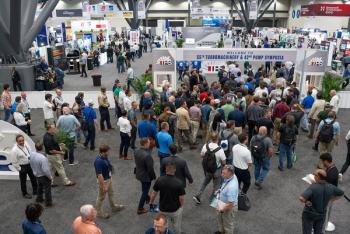
At the 2026 Turbomachinery and Pump Symposia, Opportune’s Dan Romito warned that grid constraints and a five-year gas turbine backlog are pushing AI data centers toward on-site power, while colleagues honored the legacy of the late Dara Childs.
Mee Industries CEO Thomas Mee III explains how wet compression differs from inlet fogging, what it costs compared with a new turbine and how it can help plants meet capacity commitments.
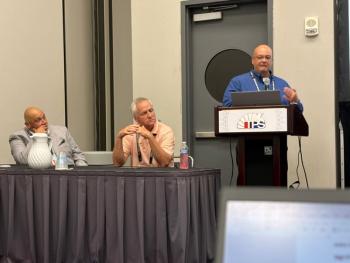
Thomas Mee III, CEO of Mee Industries, spoke with Turbomachinery International at the 2026 Turbomachinery & Pump Symposia (TPS) in Houston about wet compression, the practice of spraying a fine fog of water directly into a gas turbine's compressor to raise output. Mee Industries, based in Irwindale, California, sells the technology under the MeeFog name. Mee says the company installed its first wet compression system in 1996 and has installed several hundred since.
With new large gas turbines facing waits of several years and electricity demand rising, operators are looking for ways to add megawatts from machines they already run. In this Q&A, Mee explains how wet compression differs from conventional inlet fogging, how it can add power in small increments on demand, how its cost and lead time compare with a new turbine, and what operators should know about droplet size and water quality. Turbomachinery International
TURBO: How does traditional inlet air fogging work?
Mee: Evaporative fogging of the gas turbine's inlet air is a well-established practice used to increase power output and improve fuel efficiency. Cold air is denser than warm air so during the summer the output of the turbine drops. By evaporating tiny fog droplets in the inlet air stream, you cool the air, which increases the mass flowing through the compressor, and raises power output. Cooler inlet air also reduces the work required by the compressor, which boosts efficiency. For a typical large frame gas turbine, power is reduced by about 0.65% of the ISO rated output power for every 1°C (or 0.36% per 1°F) rise in ambient temperature. That adds up to about an 8% to 10% power boost on large turbines and a lot more on aeroderivatives. Fogging works well in humid tropical regions as well as dry climates.
TURBO: How does that differ from wet compression?
Mee: In inlet air fogging, the fog is evaporated before the air enters the compressor. Wet compression intentionally injects fog into the compressor itself. This boosts gas turbine output by virtue of the intercooling effect of evaporation that reduces compressor work. In addition, the compressor discharge temperature is reduced so more fuel is burned to reach the same firing temperature. Wet compression can produce a power increase of 5% to 10% for each 1% of water injected. For a 100 MW plant, spraying 1% (of the air mass flow) would add about 10 MW. 2% [would] gain you 20 MW of additional power. Wet compression equipment can be installed within a few days. Some wet compression users have installed systems that spray as much as 2.5% of the air mass flow.
TURBO: Is this a new technology?
Mee: No. Wet compression was first devised by Norwegian inventor Jens Williams Aegidus Elling as far back as 1903. He developed a three-stage compressor with interstage water injection for the first gas turbine that produced useable shaft horsepower. The technology was also used to generate additional thrust for fighter jets during maneuvers or for commercial jets like the Boeing 707 to produce more power during takeoff. Mee Industries installed its first wet compression system in 1996. We have since installed several hundred wet compression systems.
TURBO: What are some of the ways that wet compression has evolved in recent years?
Mee: Probably the biggest change is its ability to provide small increments of power on demand. We can build wet compression systems with many stages. This comes in handy when the grid suddenly needs more or less power. You can keep the gas turbine running at full load and use wet compression stages to add or subtract power based on demand or in accordance with the instructions from the grid operator. This helps the turbine operator to avoid frequently ramping up and down a turbine, which typically has a big impact on the amount of maintenance and repairs that are required.
TURBO: How do the economics of wet compression work out?
Mee: If you want to add more power, you can order another gas turbine or pay the OEM for expensive upgrades. Due to high demand at the moment, it might be three to five years before a new machine arrives. Wet compression can be installed during a regular maintenance window within a few days. On a per MW basis, it is about a tenth of the price of a new gas turbine. And the lead time typically is about six months or less.
TURBO: How might wet compression and fogging impact capacity payments?
Mee: Capacity markets pay a premium to plants that can add megawatts to the grid during outages or when peak demand surges. Plants are increasingly compensated for being available to run at their maximum demonstrated capacity during periods of grid stress. If the plant fails to deliver that amount when called upon, it risks penalties. There may also be hefty non-compliance penalties. Here is an example: A plant is contracted to provide 100 MW. On a 95°F afternoon, it might only be able to generate 88 MW. Adding fogging and wet compression ensures that the facility can meet its 100 MW target and be paid accordingly.
TURBO: Is wet compression growing in popularity?
Mee: Yes. Electricity demand projections indicate that we can expect heavy growth for the next five to ten years due to electric vehicle (EV) adoption and the construction of so many massive AI data centers. Hence, there is heightened interest in adding wet compression to existing plants to deliver as much power as possible and as rapidly as possible.
TURBO: Is wet compression safe?
Mee: Yes. Hundreds of MeeFog wet compression installations demonstrate that the technology is safe and effective. That said, inlet fogging must be done properly if you wish to attain the desired results. During the late nineties, some inexperienced vendors entered the market with poorly designed systems that in some cases may have contributed to blade erosion. MeeFog systems are properly designed based on almost sixty years of fogging expertise. We have recorded hundreds of thousands of hours of problem-free wet compression operation.
TURBO: What are some best practices for wet compression?
Mee: Droplet size is critical. You need correctly designed fogging nozzles that can produce billions of tiny droplets per second to expose enough water surface area to evaporate rapidly and effectively cool the inlet air. If the droplets are too large, you don't achieve enough cooling. 40-micron droplets expose one-fourth the surface area compared to the same volume of spray consisting of 20-micron droplets. 90% of MeeFog droplets are 20 microns or less and our average is about 10 microns. Additionally, you want to achieve even droplet distribution within the airflow. Therefore, a system with a larger quantity of fog nozzles at a lower flow rate works better than fewer nozzles operating at a higher flow rate.
TURBO: What kind of water should be used?
Mee: Untreated water contains minerals and this can cause blade fouling and hot-gas-path corrosion. Demineralized water should always be used for fogging and wet compression systems, unless evaporative fogging is done upstream of the air filters. You should also add drainage features to ensure no excess water is sucked into the compressor inlet.