Siemens Energy is rebranding as Omterra, unifying its gas turbine, compressor, and Siemens Gamesa wind portfolios under one corporate identity.
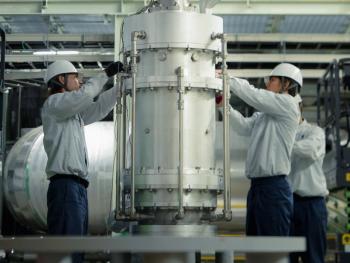
The demonstration was conducted at IHI’s dedicated test facility, engineered to simulate the operating conditions of GE Vernova’s F-class gas turbine.
IHI Corp. (IHI) and GE Vernova have successfully
“An essential piece of the ammonia value chain is now coming into place,” said Noriaki Ozawa, IHI Managing Executive Officer and President of the Resource, Energy, and Environment Business Area. “Since the signing of the joint development agreement in 2024, the collaboration between our two companies has gained strong momentum, with the efforts of both teams now bearing fruit. The successful achievement of 100% ammonia combustion in a full-scale F-class gas turbine marks a major milestone and helps reinforce the decarbonization roadmap envisioned by our customers in the power sector.”
Ammonia, widely used in industrial processes such as fertilizer production, is gaining attention as an energy carrier. When paired with hydrogen, it offers a lower-cost, more efficient option for transport and storage. In power generation, ammonia can burn without producing CO2, supporting the sector’s efforts to reduce emissions. Any air-based combustion, even if operating on a carbon-free fuel, will emit a trace amount of CO2 based on the concentration of CO2 in the atmosphere.
“The successful demonstration of running an F-class gas turbine on 100% ammonia fuel marks a pivotal step in our journey toward a lower carbon energy future,” said Jeremee Wetherby, GE Vernova’s Carbon Solutions Leader. “This achievement reinforces our development roadmap and underscores the strength of our collaboration with IHI. We see significant potential for ammonia as a carbon-free combustion fuel and are energized to continue working together to help unlock its role in advancing global decarbonization.”
In February 2026, IHI Corp. and IHI Rotating Machinery Engineering (IRM) executed a successful demonstration test for a new
A successful outcome enables the injection of supercritical CO2 into deep geological formations, like deep saline aquifers, to advance commercial carbon capture, utilization, and storage (CCUS) and progress industrial decarbonization. Unlike single-shaft, multi-stage compressors where all impellers rotate at the same speed, the geared architecture enables stage-by-stage optimization of impeller speeds, improving energy efficiency and space efficiency.
With this milestone demonstration, IHI and IRM will expand the application of their compression technologies to processes with high decarbonization potential, establish core capabilities across the CCUS value chain, and further improve system reliability. The IHI Group will help reduce environmental impact and expand decarbonization-based infrastructure, contributing to a sustainable and low-carbon society.
Also in February,Lincoln Electric System granted GE Vernova a contract to deliver two LM6000VELOX aeroderivative gas turbine packages for its