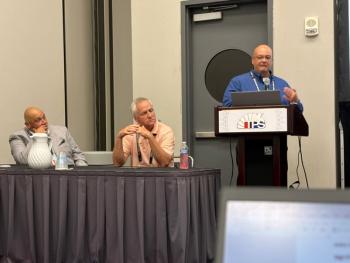
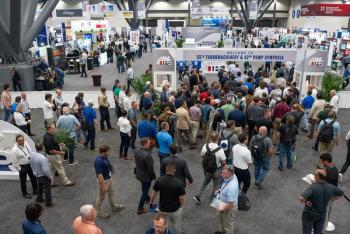
At the 2026 Turbomachinery and Pump Symposia, Opportune’s Dan Romito warned that grid constraints and a five-year gas turbine backlog are pushing AI data centers toward on-site power, while colleagues honored the legacy of the late Dara Childs.
The project successfully achieved large-capacity storage while maintaining high quality and cost efficiency by leveraging a soil-covered raised roof and advanced seismic design.
Shimizu Corp. and IHI Plant Services Corp. (IPC), an IHI Group subsidiary, announced that its
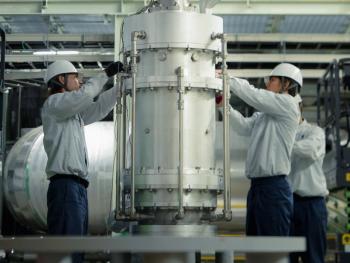
Tank construction was carried out by a joint venture between IPC and Shimizu, and, despite site constraints, the project successfully achieved large-capacity storage while maintaining high quality and cost efficiency. This was achieved by leveraging a soil-covered raised roof structure and seismic design using advanced technologies. High-strength reinforcing bars and high-compressive-strength insulation were installed to resist unprecedented pressure.
IPC was responsible for the mechanical works, including the steel roof, the inner tank (membrane), and insulation activities. Since 2013, Tokyo Gas operated the tank safely and stably without accident. During this time, the multiple advanced technologies installed have proven their reliability in actual operation. In-ground LNG storage tanks are a Japan-developed technology originating from joint development with Tokyo Gas, integrating membranes designed to accommodate expansion and contraction caused by LNG temperature fluctuation.
Since building Japan’s first in-ground LNG storage tank at the Tokyo Gas Negishi LNG Terminal in 1970, IPC has constructed a total of 37 in-ground LNG storage tanks. Alongside the expansion of LNG adoption in Japan, IPC has actively pursued larger capacity tank development. The company also has experience constructing above-ground LNG tanks in both Japan and overseas.
In March 2026, IHI Corp. (IHI) and GE Vernova successfully
Ammonia, widely used in industrial processes such as fertilizer production, is gaining attention as an energy carrier. When paired with hydrogen, it offers a lower-cost, more efficient option for transport and storage. In power generation, ammonia can burn without producing CO2, supporting the sector’s efforts to reduce emissions. Any air-based combustion, even if operating on a carbon-free fuel, will emit a trace amount of CO2 based on the concentration of CO2 in the atmosphere.
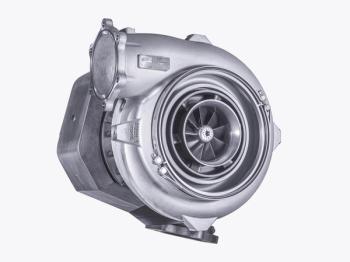
In February 2026, IHI Corp. and IHI Rotating Machinery Engineering executed a successful demonstration test for a new
A successful outcome enables the injection of supercritical CO2 into deep geological formations, like deep saline aquifers, to advance commercial carbon capture, utilization, and storage and progress industrial decarbonization. Unlike single-shaft, multi-stage compressors where all impellers rotate at the same speed, the geared architecture enables stage-by-stage optimization of impeller speeds, improving energy efficiency and space efficiency.