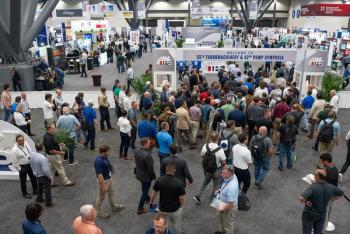
At the 2026 Turbomachinery and Pump Symposia, Opportune’s Dan Romito warned that grid constraints and a five-year gas turbine backlog are pushing AI data centers toward on-site power, while colleagues honored the legacy of the late Dara Childs.
The power plants can be connected to the grid within 12- 18 months of ordering, with availability as backup power or compensating for fluctuations in wind and solar energy.
Aligning with the German Government’s Power Plant Strategy, Rolls-Royce is launching a new modular solution for
“With our modular gas engine power plants, we are implementing the German Government’s Power Plant Strategy quickly and economically,” said Tobias Ostermaier, President of Stationary Power Solutions, Rolls-Royce Power Systems. “Our partner network ensures speed and local value creation. Utilities and data centers around the world rely on our solutions—more than 17 GWs of installed capacity speak for themselves.”
With preconfigured, factory-tested modules of 10, 20, and 30 MWs each, the power plants may be connected to the grid within 12 – 18 months of ordering. The plants are available as backup power and compensate for fluctuations in wind and solar energy, which is important during periods of low wind and low sunlight when gaps between 10 hours and several weeks must be bridged.
“True resilience comes from decentralization, not centralization,” said Michael Stipa, SVP of Strategy, Business, and Product Development, Rolls-Royce Power Systems. “An energy system based on many distributed, modular generation units is less susceptible to large-scale disruptions and bottlenecks. Modular gas engine power plants offer exactly this structure.”
The plant’s bridging capabilities provide continuous power until a connection can be made to the grid, or another power source like nuclear, at which point the gensets may switch to generating backup power. Decentralized gas engine power plants improve grid resilience and enable the further integration of renewable energies into the grid. Rather than large-scale centralized units, smaller engines may be switched on or off individually and can always be operated at optimum efficiency. These aspects benefit economic efficiency and climate protection, especially when using biomethane and biogas.
Since 2014, the United Kingdom has been relying on a capacity market to switch its energy supply from coal to renewable and gas-fired power plants. Rolls-Royce is supporting this endeavor, supplying highly efficient gas gensets to fulfill the British energy transition. Approximately 500 mtu-brand gas gensets are now operating to support the power grid.
In December 2025, Rolls-Royce supplied mtu-brand emergency power generators, verified with
This newly certified service offering provides extended maintenance intervals: Instead of monthly reviews, operators must only test their emergency power systems on a quarterly basis. The minimized check-in schedule significantly reduces both costs and emissions. The EPD International System is an independent, globally recognized organization based on the ISO 14025 and EN 50693 standards. Registered declarations contain intricate data on resource consumption, emissions, waste generation, and recyclability.