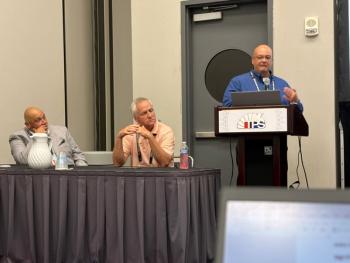
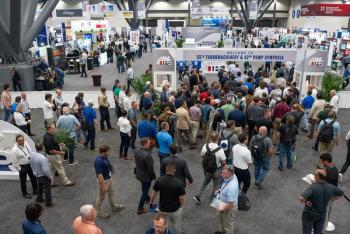
At the 2026 Turbomachinery and Pump Symposia, Opportune’s Dan Romito warned that grid constraints and a five-year gas turbine backlog are pushing AI data centers toward on-site power, while colleagues honored the legacy of the late Dara Childs.
In comparison to traditional supercomputers, quantum computing offers a notable speed advantage and may accelerate simulation time exponentially.
Rolls-Royce, Xanadu, and Riverlane—a collaboration jointly funded by Canada and the United Kingdom—have deployed
“This has been a hugely successful collaboration, which has significantly advanced our quantum applications capability,” said Leigh Lapworth, Rolls-Royce Fellow, Computational Science. “The single-minded focus on fault tolerant quantum algorithms has put us and our partners in a leading position as we enter the error-corrected era.”
Computational fluid dynamics—a method of simulating airflow—is vital for designing components in jet engines but is currently executed with traditional supercomputers. These units conduct large-scale calculations that may take months to complete, but quantum computers may provide a notable speed advantage to accelerate simulation time exponentially. Using a quantum system may enable faster design processes for large systems.
“To solve problems on a quantum computer, certain parameters of the quantum circuit need to be precomputed classically,” said Christoph Sünderhauf, Staff Quantum Scientist at Riverlane. “This process was traditionally very time-consuming. However, our research, along with that of academic groups, has significantly accelerated this step, enabling the classical pre-processing to keep pace with the quantum computation itself.”
The collaborative partners used their wide pools of expertise to precisely target the end-to-end prototyping process, demonstrating a maturing partnership for building quantum computing knowledge between Canada and the United Kingdom.
“Our efforts here successfully reduced prototyping runtimes by up to 1000-fold in some instances, overcoming the unsustainable wait times of weeks for Rolls-Royce,” said Christian Weedbrook, CEO and Founder of Xanadu. “To make quantum simulations, and more generally quantum computing, practical for Rolls-Royce, we targeted their specific application and used our Catalyst compiler to optimize PennyLane programs.”
Each participant contributed its own specialized skills and capabilities:
“Our work highlights a critical truth for industrial quantum adoption: bottlenecks won't be solved by isolating quantum from classical computing,” said Weedbrook. “We must focus on optimizing the hybrid quantum-classical structure to make these applications present a computational advantage.”
In September 2025, the European Union’s (EU) Clean Aviation program nominated Rolls-Royce to lead a project regarding decarbonized aviation—one of 12 under the Clean Aviation Joint Undertaking (CAJU) with approximately €945 million in funding. The company will lead the
Once grant preparation is successfully completed, the project will execute ground testing for an UltraFan technology demonstrator in the short-to-medium range thrust class. The technology is intended for future narrowbody aircraft, with the demonstrator testing making steps toward the future flight tests of UltraFan architecture. The CAJU program includes new aircraft concepts and next-generation propulsion technologies and is the EU’s leading research program in transforming aviation toward sustainability and climate neutrality.