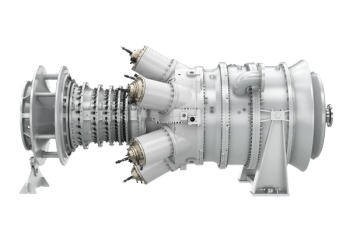
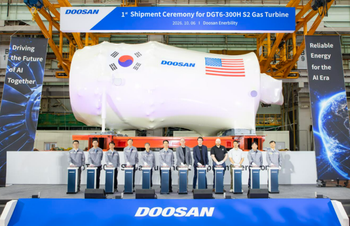
The DGT6-300H shipment is the Korean OEM's first gas turbine export to the U.S., where it says it holds 12 turbine contracts.
Sponsored by The Switch
No two turbomachinery applications are exactly alike. As a result, successful high-speed machine development needs to be shaped around all the nuances of each application and its specific requirements. At The Switch, achieving this level of customization is a process that starts well before the first component is designed.
SOLID-ROTOR TECHNOLOGY
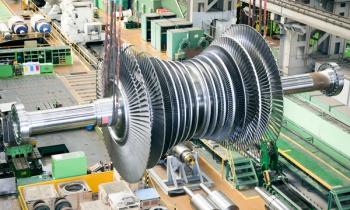
For turbomachinery, solid-rotor technology opens the door to higher speeds without compromising mechanical reliability. As the rotor is machined from a single piece of solid steel rather than assembled from multiple components, it has high stiffness and mechanical robustness, helping it withstand centrifugal forces and thermal cycling associated with high-speed operation. The technology can also enable direct-drive configurations, further reducing system complexity, footprint and maintenance needs.
But to make the most of its high-speed capabilities, the machine needs to be tailored to the specific application, operating conditions and performance requirements.
PRE-STUDY AND FEASIBILITY
Before any engineering begins, we sit down with the customer and discuss their application in detail. Understanding it inside out provides the basis for identifying suitable technologies, drawing on capabilities available in-house as well as through established partners. This close customer involvement lets us tailor machines rather than offer a one-size-fits-all product.
From there, a feasibility study can further define and evaluate the most promising and cost-effective high-speed machine concept.
DESIGN AND ENGINEERING
Turning the selected concept into a complete high-speed machine requires multidisciplinary engineering. One of the key challenges is balancing the high circumferential speed of the rotor with the need to extract as much power as possible while maintaining high efficiency. Addressing it requires close cooperation between mechanical, electrical and thermal engineers, alongside manufacturing and quality engineering.
At this stage, simulations across multiple disciplines help assess the design and identify potential issues early.
PROTOTYPE VERIFICATION AND QUALITY CONTROL
Once the prototype is assembled, it is tested to verify that the machine meets the defined performance requirements. Controlling the details throughout this stage is essential. To identify potential design weaknesses, we apply FMEA and sensitivity analysis, while supplier and manufacturing quality are controlled through structured inspection plans.
FROM 0 SERIES TO SERIAL PRODUCTION
The same rigor is carried into 0-series production. This stage confirms that design, manufacturing and supply chain all perform consistently before scaling to full serial production.
Final verification can take place either at The Switch test bench or at the customer's premises, with the test plans adapted to the customer's preferences.
CROSS-DISCIPLINARY PROJECT MANAGEMENT
Coordinating all these stages demands solid project management, since multiple disciplines and tasks must move together. For every point in the process, we bring together a technically skilled team to manage work internally and externally with customers and suppliers.
A recurring challenge is finding commercially viable supply chain options, since off-the-shelf solutions are rarely available for highly specialized machines. Close, long-term collaboration with suppliers is key.
PROVEN ACROSS DEMANDING APPLICATIONS
Since 1997, The Switch and its predecessor have supplied more than 1,000 solid-rotor machines, with no rotor failures recorded over that period. A few examples include:
The staged development path The Switch refined over the years is how these machines stay reliable at volume. Carrying the application requirements through every stage is how they remain tailored to each customer's needs.