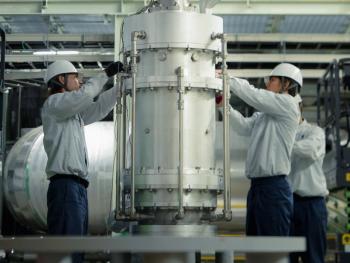
Japan Engine and Kawasaki Heavy Industries are advancing development of a hydrogen-fueled marine propulsion system under the Green Innovation Fund Project, supported by the New Energy and Industrial Technology Development Organization. The 6UEC35LSGH, described as the world’s first full-scale engine intended for installation on an actual vessel, has begun hydrogen co-firing operation in all cylinders. The engine has achieved a hydrogen co-firing ratio of over 95% at 100% load, confirming greenhouse gas reduction effects and stable operation.
Mitsubishi Heavy Industries and Kyoto University will begin operating an industry-academic laboratory on April 1: MHI Innovative Combustion Dynamics Laboratory. Research aims to build gas turbine combined-cycle power plants with over 70% efficiency and carbon-neutral combustion technology, as well as developing next-generation talent in deeply technical fields. MHI will install test rigs to illuminate the combustion mechanism of actual engines, utilize advanced measurement technology and numerical simulations to understand phenomena, and work to create combustion technology with updated concepts.
Klaus Brun and Rainer Kurz reflect on 20 years and more than 140 Myth Busters columns that sparked open debate on turbomachinery topics ranging from surge analysis to specifications, emissions, and fundamentals. Inspired by a 2005 conference dispute, the series aimed to challenge assumptions and encourage discussion without heavy sourcing. The authors credit readers, editors, and employers for support, emphasizing that while technology evolves, core engineering principles in compressors and turbines remain unchanged.
“The Rise of Sealed Compressors” explains how hermetically sealed centrifugal compressors combine the motor and compressor in one housing with magnetic bearings, eliminating shaft seals, gearboxes, and oil systems for a compact, oil‑free, low‑leakage design. This technology, developed since the 1980s, has proven reliability in subsea gas compression and industrial CO2 heat pumps, enabling rapid startups and deep decarbonization. Future growth includes remote‑operated offshore platforms and safer hydrogen compression applications.