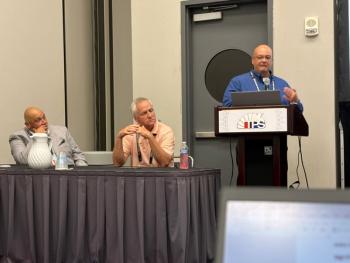
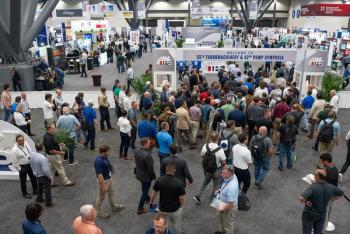
At the 2026 Turbomachinery and Pump Symposia, Opportune’s Dan Romito warned that grid constraints and a five-year gas turbine backlog are pushing AI data centers toward on-site power, while colleagues honored the legacy of the late Dara Childs.
Turbomachinery International is celebrating Klaus Brun and Rainer Kurz, the Myth Busters, for 20 years of consistent debate, exploration, and the technical breakdown of all things rotating machinery.
To our dear readers: Rainer and I (Klaus) have now been writing Myth Busters articles for 20 years. We started in early 2006 and have supplied an article to every issue and every Handbook over the last two decades—that totals over 140 articles. We have addressed many subjects in the energy industry, but a majority of the articles covered technical topics related to rotating machinery such as compressors, turbines, and pumps.
During these years, we often complained, argued, and made many predictions. We were often right and probably more often wrong, and sometimes we just stated the obvious, even if people didn’t want to hear or talk about it. At a minimum, most of our articles generated open and sometimes brutally honest discussion. That was the goal: bringing controversial turbomachinery topics to the readers and openly debating them.
I clearly remember how we started our first Myth Busters article. It was at a conference in 2005, where we had a fierce debate with a vendor of a gas turbine power-augmentation technology about the technical viability and functionality of its equipment. Rainer and I firmly believed it was mostly snake oil, but there were also some true believers in the technology. That led to the suggestion by the former editor of Turbomachinery International to write an article about it and bring the debate and the various pros and cons of this technology to the public.
At the time, the “MythBusters” show on TV was very popular and we decided to follow a similar style and format. This first article created a lot of open discussion in the industry and accomplished exactly what we set out to do: to facilitate open and respectful technical debate between industry experts. That is how the Myth Busters series was started. Turbomachinery International is celebrating Klaus Brun and Rainer Kurz, the Myth Busters, for 20 years of consistent debate, exploration, and the technical breakdown of all things rotating machinery.
Over the past 20 years, we have covered topics as complex as compressor transient surge analysis and related instrumentation, and as simple as proper painting and the foundations of machinery. Some myths were controversial and caused spirited debate. About 12 years ago, we wrote an article about the ever-increasing length of industry specifications and that nobody found the time to read them anymore—we received a lot of hate letters on that one. Another myth, about eight years ago, on greenhouse gas emissions, even resulted in feedback from government agencies.
That is good and we want debate, but we also covered topics that aimed to be more educational than controversial on basics such as compressor maps, gas turbine performance, combustion, hydrogen and CO2 compression, gearboxes, electric motors, coatings, failure analysis, and rotor and blade dynamics. Over the years, Myth Busters covered a broad scope of turbomachinery and energy industry issues. Hopefully, some of these more fundamental discussions provided valuable and practical information to our readers to help them make better engineering decisions.
When writing the Myth Busters column, our goal was always to provide arguments that are coherent and sometimes even cohesive, but not abundantly forceful or profound so as to encourage discussion, debate, and dissent. Usually, we did not cite sources, as this was not the point of the articles. Sources can be found to rationalize, justify, or counter any valid argument, but we were always sincere in our beliefs and did not merely argue to provoke.
In this spirit, we continue to ask our readers to provide us with more feedback on our topics through letters to the editor or to us directly. We plan to write Myth Busters for a couple more years; thus, we continue to seek interesting ideas for future Myth Busters topics that can be publicly debated, dissected, and disseminated. Once we run out of controversial topics in our industry, we will stop…but I doubt that will happen soon.
Over the past 20 years, there have been many changes in the turbomachinery industry—much of it good, but also some bad. Many hypes have come and gone. There were booms and busts. Some money was wasted on stupid ideas. Many technologies we believed were promising did not come to fruition, outright failed, or crashed badly when tried. In general, though, technology has drastically improved, especially in the areas of aerodynamics, combustion, controls, emissions reduction, and instrumentation.
But a compressor is still a compressor, a gas turbine still functions the same, and an expander usually expands a gas and not a liquid. The fundamentals of technology haven’t changed. That is why in most of our articles, Rainer and I, being old-school engineers, focused on the physics and the function, not the newest gimmick or wild claims by start-up technology providers and academics. We hope that these articles provided something valuable to the industry, even if we were not always right.
We want to thank Turbomachinery International for giving us a forum over the past 20 years; its editorial support and patience have been amazing. Over the years, we have worked with five different editors and all of them have been professional, engaging, and helpful. Rainer and I have had both long and happy careers in the turbomachinery industry.
Rainer worked first at Borsig (which later became part of GHH, MAN, and is now Everllence) and then for many years at Solar Turbines. I started my career at Solar Turbines, then worked at General Electric (now GE Vernova and Baker Hughes) and Southwest Research Institute, and now for nearly eight years at Ebara Elliott Energy. We are thankful that these companies allowed us the freedom and gave us the time to publish our articles. And, as many of you know, Rainer and I have not only published Myth Busters articles, but also several textbooks and hundreds of technical articles together. Many of these articles formed the foundation or added to the debate of the Myth Busters articles.
And finally, but most importantly, we want to thank our readers. Many of you are good friends and colleagues. The nice thing about our industry is that we can have arguments one day and happily drink beer together the next. This industry is a small world—there are probably only several thousand turbomachinery engineers, and we are thankful to have met and gotten to know many of you, often through debate about our articles. Without your ideas, support, and feedback, the Myth Busters series would not have been possible.
About the Authors
Klaus Brun is the vice president of product and technology at Ebara Elliott Energy. He is also the past chair of the Board of Directors of the ASME International Gas Turbine Institute and the IGTI Oil & Gas Applications Committee.
Rainer Kurz is a recent retiree as manager of gas compressor engineering at Solar Turbines Inc. in San Diego, California. He is an ASME fellow and has published over 200 articles and papers in the turbomachinery field.
6 months ago
Myth: High-Pressure Gas Pipelines are the Future7 months ago
The Rise of Sealed Compressors7 months ago
Turbomachinery International: March 2026