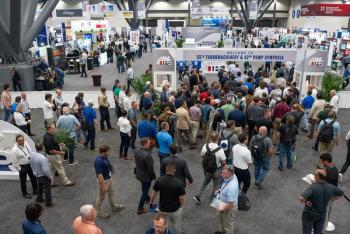
At the 2026 Turbomachinery and Pump Symposia, Opportune’s Dan Romito warned that grid constraints and a five-year gas turbine backlog are pushing AI data centers toward on-site power, while colleagues honored the legacy of the late Dara Childs.
Growing orders for Mk10.7 two-stroke engines reflect a market preference for dual-fuel readiness without locking vessels into a single decarbonization path.
Everllence is seeing sustained momentum for its
As of April 2026, Everllence’s orderbook features over 160 Mk10.7 engines, highlighting a significant market confidence in the maritime platform. The company views this momentum as validation of the Mk10.7 platform’s role as a strategic foundation for modern newbuilding projects. Recently, the Yantai CIMC Raffles shipyard ordered 8 x 6G70ME-C 10.7 LGIM engines in connection with the construction of eight container ships for Hapag-Lloyd. Hanwha Engine will build the engines in South Korea with an option for six further engines.
“Today’s shipowners are navigating a dual challenge: advancing the energy transition while safeguarding energy security and commercial resilience,” said Bjarne Foldager, Head of Two-Stroke at Everllence. “What we are seeing with Mk10.7 is not a shift towards a single fuel but a clear preference for flexibility. Owners want solutions that allow them to move forward on decarbonization without locking themselves into one pathway prematurely.”
The Mk10.7 platform is Everllence’s newest generation of two-stroke engine design, developed with classic design principles and a modular architecture that supports conventional fuel operation and dual-fuel configurations, including methanol and methane. This strategy allows shipowners to make investment decisions while retaining the flexibility to adapt to evolving fuel supply chains, regulatory frameworks, and decarbonization pathways over a vessel’s lifetime.
“The Mk10.7 platform is designed precisely for this flexible market reality,” said Christian Ludwig, Vice President and Head of Global Sales & Promotion, Everllence. “By offering a common, robust engine architecture across conventional fuel and multiple dual‑fuel options, we enable shipowners to balance efficiency, reliability and future optionality. This combination is increasingly becoming a cornerstone of energy security in newbuilding projects.”
Leveraging a modular architecture, the Mk10.7 provides high efficiency based on well-proven design principles while delivering pathways for conversion to alternative fuels. This applies across numerous vessel segments, including container vessels, pure car and truck carriers, tankers, and bulk carriers supporting different operational profiles and trade patterns.
Earlier this month, per order from
The ferries comprise a new major vessel (NMV) class designed to replace aging vessels on BC Ferries’ busiest routes. This project represents the company’s largest-ever capital investment – the NMVs are being constructed with future sustainability and all-electric operation in mind. Fully electric operation will become possible when the necessary infrastructure becomes available.