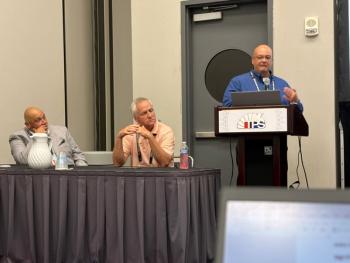
At the 2026 Turbomachinery and Pump Symposia, John Crane’s Brian Kalfrin explained why volatile natural gas liquids demand custom-engineered seals, from face material selection to installation and flush rates.
New AEDS tools integrate cooling
Concepts NREC has completed a Small Business Innovation Research (SBIR) project funded through the Department of the Air Force's AFWERX program, delivering a suite of new cooling and secondary flow design capabilities within its Agile Engineering Design System® (AEDS). The project, conducted between June 2024 and March 2026, represents a significant step toward integrated turbomachinery design workflows — bringing secondary flow analysis out of isolation and into the core design process.¹
For turbomachinery engineers, cooling circuits and secondary flow paths have historically been treated as afterthoughts — modeled late in the design cycle using disconnected tools, simplified assumptions, or omitted entirely from early-stage analyses. The consequences are significant: performance predictions that diverge from physical testing, thermal management shortfalls, and costly design iterations.
"Cooling and secondary flow paths play a critical role in turbomachinery performance, yet they have often required disconnected analyses, simplified assumptions, or are ignored completely," said Melissa Seib, senior CAE software product manager at Concepts NREC. "This project allowed us to bring these capabilities directly into our CAE software, giving engineers a more connected workflow and better insight into how these flow paths influence overall machine performance."¹
The completed project introduced several new technical capabilities across the AEDS platform, with initial functionality available in the current release and additional features planned for a November 2026 rollout. Key developments include:¹
Among the project's most technically significant outputs is the new labyrinth seal model. Leakage through labyrinth seals is a well-documented source of efficiency loss and thermal loading uncertainty in gas turbines and high-speed compressors. Accurate prediction of seal leakage — particularly for stepped configurations common in modern designs — has been a persistent modeling challenge.²
Concepts NREC reported the model was validated through a comprehensive study, with results accepted for presentation at ASME Turbo Expo 2026 in Milan, Italy.¹ Peer-reviewed acceptance at Turbo Expo, the premier annual forum for turbomachinery research, lends meaningful technical credibility to the model's fidelity.
The project's defense pedigree — funded through AFWERX, the innovation arm of the Air Force Research Laboratory — underscores the operational relevance of improved secondary flow modeling. AFWERX has awarded more than $7.24 billion in contracts since 2019 with the stated aim of accelerating technology transition to operational capability.¹
But the implications extend beyond aerospace and defense. Any turbomachinery application where thermal management and parasitic leakage flows influence efficiency — including industrial gas turbines, turbochargers, and supercritical CO₂ power cycles — stands to benefit from earlier, more accurate secondary flow modeling in the design loop.
"The research completed through this effort advances our underlying modeling technology, creating a foundation for more accurate and integrated turbomachinery analysis for years to come," said Mark Anderson, chief technology officer at Concepts NREC.¹