
Siemens Energy's Gas Services orders surged 62% to a record as the company joined GE Vernova and Baker Hughes in reporting a record turbomachinery quarter.
Although Malaysia’s decarbonization efforts focus on hydropower and solar, Everllence’s gas engines can balance fluctuating renewable input with short response times and high efficiency.
Everllence will deliver 14 large-scale gas engines, totaling over 240 MW of combined output, to three new
“Malaysia is a market with momentum in terms of industrial development, energy demand, and climate goals,” said Martin Chmiela, Head of Power, Asia Pacific at Everllence. “The State of Sabah alone aims to increase its share of renewable energy to 35% by 2035. With our efficient and flexible engine technology, we are contributing to the energy transition as a partner to renewables ensuring a reliable grid power source.”
The power generation market is typically dominated by gas turbines, but engine-based power plants are gaining traction due to short response times and high efficiency at partial loads. Everllence’s gas engines, specifically the 18-cylinder 51/60DF, are designed to balance fluctuating renewable input for grid stabilization or continuous operation.
Kibing Solar New Materials is expanding its solar glass factory near Kota Kinabalu, ordering a new 18V51/60DF generator set (genset) with over 18 MW of power output. The energy will be allocated toward production processes—an example of decentralized industrial self-generation, independent of the public grid. This genset builds on 64 MW of existing installations provided by Everllence when the facility was constructed. Commissioning is scheduled for Q1 2026.
Also, Everllence signed a contract with KAB Energy Holdings to deliver seven 18V51/60DF engines for a new gas-fired power plant on Labuan Island offshore Borneo. The plant will replace retiring assets, supply 120 MW for the local grid, and serve a rapidly growing manufacturing presence in the region. Commissioning is planned for year-end 2026, with KAB Energy Holdings executing engineering, procurement, and construction.
Everllence conducted a similar project in Sipitang, Sabah, supplying seven 20V35/44G gas engines to an under-construction power plant that will generate decentralized energy for an FLNG extraction platform. With a potential output of over 70 MW, the engines will sufficiently address demand at the 52-MW power plant. The company’s installations in Sipitang and on Labuan Island simplified maintenance work and staff training, offering a time-saving advantage in day-to-day operations.
Lastly, Everllence is shipping six 18V51/60DF engines to a power plant in Kimanis, Sabah, with a total output of approximately 100 MW. This plant will also generate power for the state grid to help meet the region’s rising energy demand.
In early November, Everllence began an industrial-scale heat pump project to install the world’s
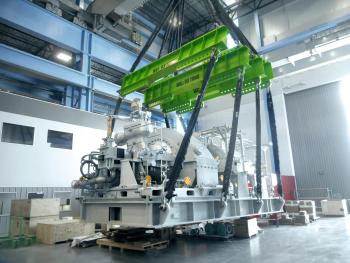
Everllence’s system combines a vapor compression cycle with steam compression, generating high-pressure steam up to 50 bar and over 300 °C. To achieve this pressure and temperature, the system integrates two multi-shaft integrally geared compressors: type RG40-8 for refrigerant compression and type RG63-6 for steam compression.