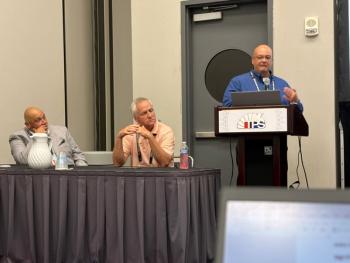
At the 2026 Turbomachinery and Pump Symposia, John Crane’s Brian Kalfrin explained why volatile natural gas liquids demand custom-engineered seals, from face material selection to installation and flush rates.
Eliminating unsteady load, modifying component geometry, and/or damping the entire system may reduce unwanted fluid-structure interactions and prevent turbomachinery damage.
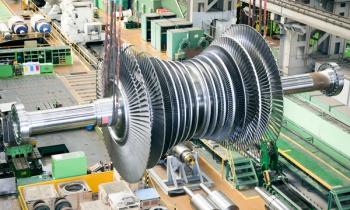
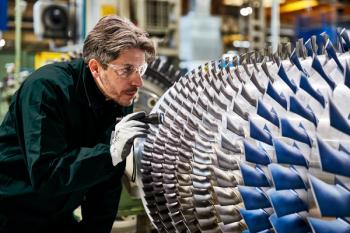
Fluid-structure interactions, also known as flow-induced vibrations, have affected many turbomachines, including compressors, pumps, steam turbines, gas turbines, fans, and blowers. Flutter is the self-excited vibration of turbomachinery components (such as blades, impellers, and others) due to the interaction of structural-dynamic and fluid-dynamic forces. This is a problem for many turbomachines, as it can lead to dramatic damage or component loss in the short term and high-cycle fatigue in the long term.
The sources of unsteady aerodynamic loads acting on different turbomachinery components can be characterized as either external or self-induced. External sources, such as wakes from other rotating or static components upstream, are relatively well understood, and their effects can be predicted. Self-induced sources are typically characterized by the feedback between the flexible components and the unsteady fluid dynamics. These sources are more difficult to predict and rectify.
The fluid-dynamic loads associated with these vibrations can be classified as either weak-coupled or strong-coupled with respect to the motion of the turbomachinery’s components, such as the blade motion. Weak-coupled fluid-dynamic loads are not significantly influenced by component motion (vibration of the part/structure), and potential vibration issues can be addressed relatively easily.
Strong-coupled fluid-dynamic loads depend implicitly on the motion of the component (dynamic vibration of the part or structure), which can either attenuate or amplify vibrations. In other words, there is a strong coupling between the fluid loads and the dynamic vibration of the component. The rate at which the vibration amplitude grows or decays is usually described by the total damping, which is a combination of structural/part damping and fluid-dynamic damping associated with strong-coupled fluid-dynamic loads.
Some turbomachines, such as modern axial compressors and high-pressure turbines, tend to have very little structural damping; therefore, fluid-dynamic damping can constitute most of the total damping. Changes in fluid-dynamic damping can profoundly influence the turbomachinery structural dynamics, which in turn affect the durability of the components under load. These effects can reduce the component fatigue life and, eventually, shorten the turbomachinery’s service life.
The fluid-structure (fluid-component) interaction is particularly important for many turbomachines. Typically, those turbomachines operate in a wide range of rotational speeds and variable loads. Consequently, there are many possible intersections between the excitation and the natural frequencies of components (such as impellers, blades, etc.) with the potential for resonant vibration.
The current trend in the turbomachinery industry to increase the efficiency, loads, and power density makes the situation more challenging: Constantly optimizing the sections and thicknesses of different parts and components would cause some difficulties in this regard. Modern components in turbomachines, such as blades and other rotating parts, are under large fluid-dynamic loads and are structurally flexible, resulting in potential premature component failure due to vibrational fatigue. All this, combined with ever-increasing load ranges and speed ranges, can increase risks and potential for failures.
There have been different solutions to avoid fluid-structure (fluid-component) interactions, associated vibration, and fatigue failure. The first is to decrease or eliminate the unsteady load responsible for the vibration. The second is to modify the components’ design and geometry to reduce interactions or cyclic stresses. The third is to increase the damping of the components or total damping of the system. Some advanced turbomachinery practices, such as using thorough dynamic simulations and investigations, have reduced the magnitude of forced excitations in turbomachinery components.
However, not all sources of forcing can be eliminated while allowing the stages or parts to meet performance requirements. Alterations in the geometry of components and parts of a turbomachine to reduce cyclic vibratory stresses might be risky, expensive, and even problematic. There were cases in which such a change negatively impacted the performance or operational fluid-dynamic capabilities of the turbomachinery. This can adversely affect the operation, efficiency, or reliability.
The damping of a part is a measure of the rate at which vibration energy is dissipated. Ideally, different components would be provided with high damping such that most of the energy that is being transferred to the component from the dynamic forcing is dissipated (as heat) rather than used to cause damage (such as to nucleate and grow cracks in the structure). However, there are many practical limitations to such an ideal goal.
Amin Almasi is a chartered professional engineer in Australia and the United Kingdom. He is a senior consultant specializing in rotating equipment, condition monitoring, and reliability.
6 months ago
Myth: High-Pressure Gas Pipelines are the Future7 months ago
The Rise of Sealed Compressors7 months ago
The Myth Busters: 20 Years in Review7 months ago
Turbomachinery International: March 2026