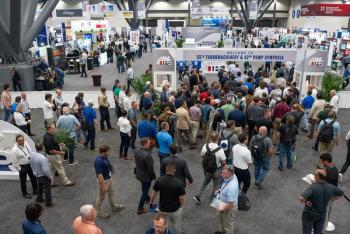
At the 2026 Turbomachinery and Pump Symposia, Opportune’s Dan Romito warned that grid constraints and a five-year gas turbine backlog are pushing AI data centers toward on-site power, while colleagues honored the legacy of the late Dara Childs.
High-pressure gas pipelines may be vital to increasing natural gas transportation capacity, but certain cost, compression, and materials challenges present widespread integration roadblocks.
Natural gas is transported in pipelines and pipeline networks. In the United States, pipeline construction is booming due to the large international demand for LNG and the domestic demand of natural gas to fuel power generation for data centers. An idea to increase the transport capacity could be the use of so-called high-pressure pipelines that operate at pressures above 1,600 or 1,800 psi. Currently, installed pipelines are rated at about 1,500 psi (ANSI 600) or below.
It has been highlighted that significant improvements in transportation efficiency can be made by using ANSI 900-rated pipelines, which would allow operating pressures up to 2,250 psi. Besides subsea pipelines, very few land-based natural gas pipelines are designed for these pressures, although several have been projected.
On the other hand, CO2 pipelines have been built at these pressures and allow CO2 to flow in dense phase at supercritical conditions, combining very high density and attractively low viscosity. Arguably, CO2 under these conditions is neither a gas nor a liquid but a supercritical fluid; therefore, we see arguments as to whether the machines transporting the fluid are called pumps or compressors. While the critical pressure and temperature for natural gas, depending on composition, is between 670 psi and -115 °F (pure methane) and 1,200 psi / -33 °F (for natural gas with about 82% methane and heavier hydrocarbons), CO2 has its critical point at 1,074 psi and 88 °F.
This points out the first hurdle: A natural gas pipeline will typically not have an operating temperature close enough to the critical temperature to reap the same benefits as CO2 pipelines, even though the pressures required can be easily reached. Nevertheless, natural gas pipelines for heavier natural gas have been built, although at operating pressures of about 1,800 psi, and discussions have included high-pressure pipelines in Canada and Alaska.
Another problem is the cost to build such a pipeline. Flanges, valves, coolers, compressors, and other devices must be built with ANSI 900 ratings and are therefore not off the shelf, but customized—this is a big cost driver. The pipe materials themselves would be higher-grade steel, and higher wall thicknesses are required. This makes not only the pipe significantly more expensive but also increases the cost of laying the pipe. Higher-grade pipeline steels are often not readily available in the quantities needed.
If such a pipeline has to interface with lower-pressure pipelines, there is some inefficiency due to the cost of compression from a lower to a higher pressure, and the difficulties in expanding efficiently (i.e., with an expander rather than a valve) to lower pressures. This may not be significant for long pipelines, but it certainly affects shorter pipelines. The cost of compressing from field pressure to the pipeline’s inlet is also significantly higher.
Studies have shown that high-pressure pipelines can reduce the installed power compared to lower pressure pipelines, but the capital expense increases significantly for pipeline pressures over 1,500 psi. Other studies, evaluating the combined impact of capital expense and operating expense over a 20-year project life based on net present value, show that there is no advantage of a 2,200-psi pipeline versus a 1,500-psi pipeline, especially when estimate uncertainties must be considered. This also does not include the higher cost of compression due to the increased pressure at head stations. This added compression is more disadvantageous as the pipeline gets shorter.
There are exceptions: Studies on land-based pipelines rightfully assume an optimum distance between compressor stations. On a subsea pipeline, there is generally no opportunity to boost the gas pressure. In such cases, the benefits of higher operating pressures (which can be as high as 3,000 psi) become more pronounced. In fact, optimum operating pressures become higher the longer the subsea part of the pipeline becomes. Similarly, in very remote areas where construction and upkeep of compressor stations is more expensive and challenging, higher operating pressures might be advantageous.
Off-course higher pressure in a pipe will increase the release of gas in case of ruptures and possibly increase the amount of gas release if sections must be evacuated for repairs. The general risk level for high-pressure pipes increases. In this context, it should be noted that the number of incidents for pipeline transportation is at least an order of magnitude lower than for road transport or rail transport.
So, are high-pressure gas pipelines in our future? CO2 pipelines, once carbon capture and storage takes off, will almost certainly take advantage of transporting CO2 in the dense phase, especially over longer distances. Subsea pipelines for natural gas, especially over longer distances without an opportunity for boost compression, will certainly be operated at pressures higher than 1,600 psi. However, natural gas transport will rarely see pipelines that exceed 1,600 psi operating pressure.
About the Authors
Klaus Brun is the vice president of product and technology at Ebara Elliott Energy. He is also the past chair of the Board of Directors of the ASME International Gas Turbine Institute and the IGTI Oil & Gas Applications Committee.
Rainer Kurz is a recent retiree as manager of gas compressor engineering at Solar Turbines Inc. in San Diego, California. He is an ASME fellow and has published over 200 articles and papers in the turbomachinery field.
7 months ago
The Rise of Sealed Compressors7 months ago
The Myth Busters: 20 Years in Review7 months ago
Turbomachinery International: March 2026