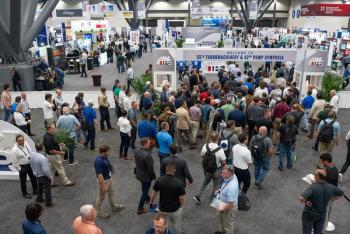
At the 2026 Turbomachinery and Pump Symposia, Opportune’s Dan Romito warned that grid constraints and a five-year gas turbine backlog are pushing AI data centers toward on-site power, while colleagues honored the legacy of the late Dara Childs.
GE Aerospace is buying castings maker CPP for $11.75 billion, a week after SpaceX confirmed plans to cast its own gas turbine blades in-house.
GE Aerospace said it has agreed to acquire Consolidated Precision Products (CPP), a major manufacturer of precision castings, for $11.75 billion. The deal lands roughly a week after SpaceX confirmed it is building its own foundry to cast gas turbine blades and vanes, rather than continue buying them from outside suppliers. The two moves, taken together, have put an unusually obscure link in the turbomachinery supply chain, superalloy investment casting, squarely at the center of industry attention.
CPP, headquartered in Cleveland, Ohio, makes investment and precision sand castings for commercial and military aircraft engines, industrial gas turbines and other mission-critical components. It has roughly 6,600 employees across more than 20 facilities, and GE Aerospace has bought from the company for more than 15 years.¹
GE Aerospace Chairman and CEO H. Lawrence Culp Jr. framed the deal around overall capacity rather than any single competitor. He said investment in mission-critical casting capacity is needed to meet simultaneous demand across commercial engines, aftermarket parts and defense.¹ Culp told Barron's that after years of balance-sheet repair, GE Aerospace is now in a position to make an investment of this scale in a commodity as critical as castings.² The deal values CPP at roughly 18 times estimated 2027 EBITDA including expected cost synergies, or about 26 times without them. That's in the same range as rival castings maker Howmet Aerospace's current trading multiple, according to Barron's.² The transaction is expected to close in the second half of 2027, pending regulatory approval.¹
The GE deal comes days after Elon Musk confirmed, in a weekend post on X, that SpaceX is building a foundry in Bastrop, Texas, to cast the blades and vanes used in large natural-gas turbines. Musk said in-house casting could accelerate new gas turbine deployment by as much as 18 months, and he called the potential impact "a profound game-changer."³ SpaceX had been advertising engineering roles for a "Blades and Vanes Foundry" at the Bastrop site since April. Separately, satellite-land-purchase research cited by Morgan Stanley found the company acquired roughly 830 acres near its existing Starlink factory there between March and June.⁴
Hot-section turbine blades and vanes are widely reported to be one of the tightest constraints in the gas turbine supply chain. Historically, only three or four foundries worldwide have been able to cast them at the required precision, and order books are reportedly booked out toward 2030.³ GE Vernova, Siemens Energy and Mitsubishi Power together account for more than three-quarters of the world's installed heavy-duty gas turbine base, according to S&P Global data cited by the Financial Times.⁸ A fully functioning in-house foundry wouldn't remove every obstacle SpaceX faces, either. Getting a gas-fired plant running also depends on specialized installation crews and other steps that casting alone doesn't solve, the FT notes.⁸ Morgan Stanley analyst Adam Jonas has also noted that the same Bastrop facility could produce castings for SpaceX's Raptor rocket engine turbopumps, which would let the company spread the foundry's cost across both its space and AI infrastructure businesses.³
SpaceX's interest in the bottleneck isn't abstract. The company already generates revenue renting data center capacity to AI developers including Anthropic and Google, and those two deals alone are estimated to account for roughly a quarter of SpaceX's projected revenue next year, according to S&P Capital IQ data cited by the Financial Times.⁸ The more electricity SpaceX can bring online, the more of that business it stands to capture.
The Bastrop foundry isn't Musk's only move against the bottleneck. SpaceX is reported to have acquired APR Energy, which operates a fleet of mobile gas and diesel turbines, for roughly $1 billion earlier this year. The company has also already been running mobile turbines at a site in Mississippi, under an arrangement with local regulators to eventually swap them for a permanent power plant.⁸
Investors read the two moves as directly connected, even though GE Aerospace's own announcement doesn't mention SpaceX. Howmet Aerospace, the industry's largest independent castings supplier, fell as much as 7.7% in the days immediately after Musk's post. That's part of a broader decline of roughly a fifth in its stock since mid-August, even though shares still trade at more than 40 times this year's earnings, according to S&P Capital IQ estimates cited by the Financial Times.⁵ ⁸ Shares of GE Vernova and Siemens Energy also dipped modestly on the SpaceX news, reflecting investor uncertainty about whether a vertically integrated new entrant could eventually compete for turbine business more broadly.⁶ Jefferies analyst Sheila Kahyaoglu described the investment-castings market as now being in "war games mode."²
Not every analyst reads SpaceX's ambitions the same way. Research firm 22V Research has argued SpaceX is more likely aiming to produce its own replacement parts than to challenge established turbine and castings makers directly.⁶ The picture for the three big turbine OEMs themselves is mixed too. A more competitive, higher-capacity castings supply chain could end up benefiting GE Vernova, Siemens Energy and Mitsubishi Power as much as it threatens them, even if a capable new entrant on their own turf is an unsettling prospect in the meantime.⁸
Gas turbine blades and vanes operate in the hottest section of the engine, at temperatures reported to run as high as 3,000 to 3,600 degrees Fahrenheit. That's above the melting point of the superalloys the parts are made from, and it's why single-crystal investment casting is so difficult to master and so slow to scale.⁷ That narrow, specialized manufacturing step is a large part of why large-frame gas turbine OEMs have amassed years-long order backlogs as data center demand has surged.
Whether SpaceX can cast blades reliably at commercial scale remains unproven. Established manufacturers have spent decades refining the process. Musk may not need to succeed at scale for the effort to matter, though. Simply being a credible threat could be enough to push established manufacturers to expand their own casting capacity faster than they otherwise would.⁸ GE Aerospace spent nearly $12 billion securing its own castings supply the same week SpaceX's ambitions became public. That timing suggests the industry is already treating the threat, or the opportunity, as real.