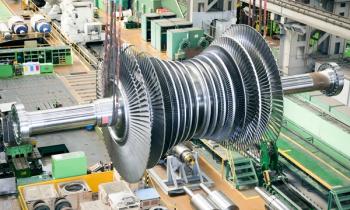
When renewables take priority on the grid, gas turbines must start fast, ramp hard, and run low, or risk forfeiting revenue entirely. Luca Buzzoni, Head of Service Engineering at Ansaldo Energia, explains how coordinated hardware upgrades, advanced controls, and digital monitoring are enabling existing gas turbine fleets to meet the flexibility demands of modern, renewable-heavy grids. Buzzoni details how combustion system enhancements, hot-gas-path component improvements, and purpose-built predictive algorithms work together to reduce minimum environmental load, increase cycling capability, and sustain reliability without sacrificing long-term asset value. Tune into the podcast for the full conversation!
Advertisement
Key Learning Objectives:
Understand why operational flexibility has become a core requirement for gas turbines displacing base-load design assumptions.
Learn how Ansaldo Energia's coordinated upgrade portfolio addresses combustion systems, hot-gas-path components, auxiliary systems, and controls in parallel to deliver full plant flexibility.
Discover how lowering minimum environmental load (MEL) gives operators a decisive commercial advantage when competing against alternative technologies during low-price grid periods.
Explore how remote monitoring and AI-driven predictive analytics sustain availability as cycling rates increase and operating conditions grow less predictable.
See how Ansaldo Energia's single integrated R&D organization ensures legacy fleet operators can access the same engineering advances as buyers of new-build units.
The company raised $8 million to commercialize factory-built supercritical CO₂ systems designed to recover exhaust heat from simple-cycle gas turbines.
At the 2026 Turbomachinery and Pump Symposia, Engro Fertilizers’ Muhammad Uzair Javed explained how his team traced persistent high vibration to train misalignment, then moved a 100-ton turbine skid to cut vibration in half.
At the 2026 Turbomachinery and Pump Symposia, Opportune’s Dan Romito warned that grid constraints and a five-year gas turbine backlog are pushing AI data centers toward on-site power, while colleagues honored the legacy of the late Dara Childs.
At the 2026 Turbomachinery and Pump Symposia, John Crane’s Brian Kalfrin explained why volatile natural gas liquids demand custom-engineered seals, from face material selection to installation and flush rates.
The two-frame platform for two-stroke marine engines is built around a cartridge design that lets operators exchange the rotating assembly during port calls.