
Siemens Energy is rebranding as Omterra, unifying its gas turbine, compressor, and Siemens Gamesa wind portfolios under one corporate identity.
The November/December 2025 issue covers steam turbine blade dynamics and aerodynamics, gas turbine bucket repair, a TPS 2025 recap, a Q&A with Ebara Elliott Energy, and much more.
Turbomachinery International’s November/December 2025 issue is live and includes insights from Nikon Corp., Ebara Elliott Energy, the Myth Busters Klaus Brun and Rainer Kurz, Amin Almasi’s Turbo Tips, and the 2025 Turbomachinery & Pump Symposia.
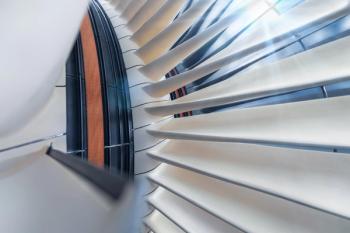
The cover story, Steam Turbine Optimization for Mechanical Drive Applications, Part 2: Blade Dynamics and Aerodynamic Performance, shifts the focus from aerodynamic design to the mechanical challenges that shape turbine durability and long-term performance. This section explores how blade geometry, stress distribution, material properties and dynamic forces—including oscillatory stimulus and harmonic excitation—interact to influence reliability. It also outlines methods for managing mean and alternating stress, showing how trade-offs in mass, shape, frequency response and damping affect blade life. Click
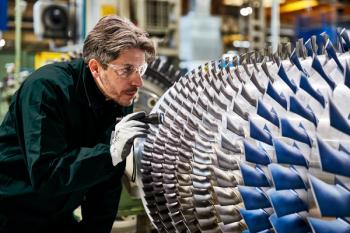
Also in this issue, Mark Axford of Axford Turbine Consultants delves into gas turbine blades and buckets and how automated laser-welding technology represents a paradigm shift in repair and maintenance. It addresses key industry challenges—labor shortages, quality consistency, and operational downtime—while delivering measurable improvements in efficiency and cost control. He also discusses a specific industry example: Nikon Corp.’s Lasermeister laser processing machines.
“A key benefit of the Lasermeister solution is its ability to streamline the bucket repair process through the integration of scanning, data processing, and automated welding,” said Axford. “The workflow begins by mounting multiple worn turbine buckets onto a custom-designed jig, which ensures the precise positioning of each part throughout the process.”
The
Furthering this edition’s coverage of TPS 2025, Turbomachinery International sat down with
“Canned motor pumps have a canned motor stator and they’re similar to submerged motor pumps, which have been used in LNG for a long time,” said Brautigam. “The canned motor stator is wrapped in a thin layer of stainless steel, similar to tinfoil, to keep out the ingress of ammonia. The magnetically coupled pumps are a relatively straightforward design. The pump and motor are on separate shafts connected by a magnetic coupling, and, in this design, a pressure barrier separates the outer rotating magnets from the inner rotating magnets to create a contactless, sealless pump.”
The Turbo Tips column defines stress concentrations in turbomachinery, identifies causal factors, and provides a series of solutions and practical notes to avoid stress-related failures: manufacturing parts in specific shapes, chamfering or filleting sharp edges, and achieving uniform distribution. On the Myth Busters side, Klaus Brun and Rainer Kurz dispel the myth that axial compressors outperform modern centrifugal designs in high-flow applications.
10 months ago
How to Manage Stress Concentrations in Turbomachines